TMA and Telkom University Strengthen Industry–Academia Synergy Through AI-Based Social Media and News Analytics Project
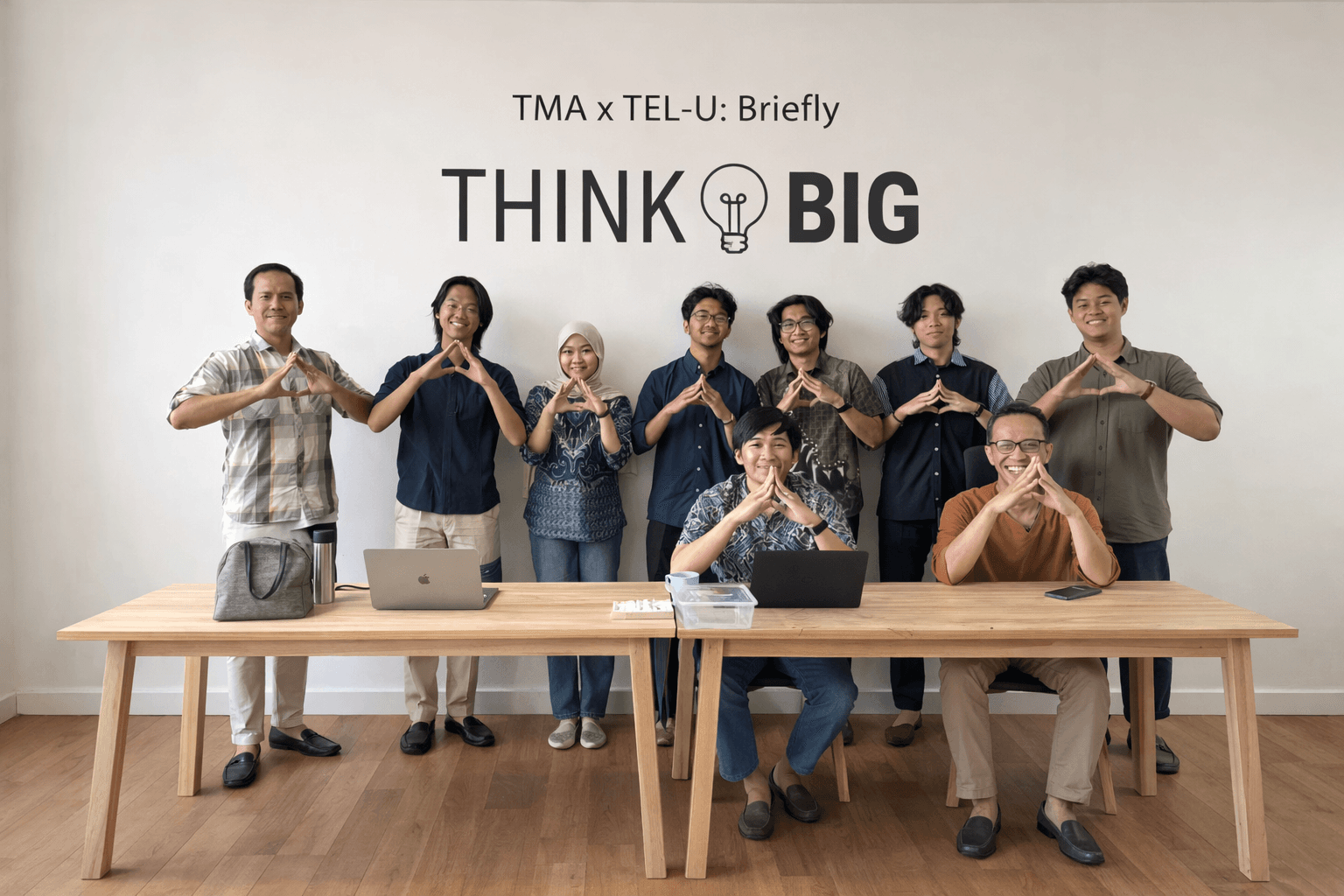
In today’s rapidly evolving digital transformation era, collaboration between industry and academia has become a critical factor in developing digital talent capable of addressing real-world challenges. As a technology company focused on data solutions, artificial intelligence, and digital platforms, PT Teknologi Mahakarya Asia (TMA) continues to strengthen its commitment to building strong partnerships with leading universities, including Telkom University (Tel-U).
The collaboration between TMA and Telkom University extends far beyond internship and fieldwork programs. It encompasses project mentoring, technical training, skills development, research collaboration, and exposure to real industry challenges. Through this approach, students gain not only academic knowledge but also practical experience in developing solutions that address actual business needs.
One of the most notable outcomes of this collaboration is a final-year student project from the Informatics Study Program, Faculty of Informatics, Telkom University. The project team was led by I Made Dwi Wiryawan Raditya as Project Manager and supported by fellow team members serving as AI Engineers, Front-End Developers, Back-End Developers, and Quality Assurance Engineers (M. Reyenno Rakhazhillan S., Farhan Ahmad Naufal, Galuh Ambar Setiana, Fransiskus Harris B. dan Timothy Hinsan Widjaja, Rizky Abadi).
The culmination of the program took place on June 12, 2026, when the student team presented their final project to academic supervisors, industry mentors, and stakeholders involved in the university–industry collaboration initiative.
The project focused on a highly relevant challenge in the digital age: helping users cope with the growing phenomenon of information overload caused by the enormous volume of digital news published every day. The team identified that business analysts, journalists, researchers, and decision-makers often struggle to monitor public sentiment, emerging trends, and sectoral impacts quickly and objectively because they must manually review information from numerous news sources.
To address this challenge, the students developed Briefly – News Summarize AI Agent, an AI-powered platform capable of automatically collecting news, clustering related topics, generating summaries, performing sentiment analysis, and predicting sectoral impacts through an end-to-end automated process.
What makes the project particularly impressive is that it was designed not only as an academic exercise but also as an industry-oriented solution following modern engineering principles. Briefly utilizes an asynchronous AI pipeline consisting of four core workers responsible for news scraping, smart clustering, summarization and sentiment analysis, and sectoral impact prediction, all integrated into an interactive web-based dashboard.
At the first stage, the system automatically gathers news articles from various Indonesian news portals through Google News RSS feeds and extracts relevant content using open-source technologies. The collected articles are then grouped through embedding and clustering techniques, enabling news stories covering the same topic to be consolidated into a single cluster. Next, the AI engine generates concise summaries and analyzes the sentiment associated with key actors mentioned in the articles. Finally, the platform predicts which industry sectors are likely to be affected by the reported events.
The processed results are then displayed through an interactive dashboard that allows users to search, filter categories, review news summaries, analyze sentiment, and access AI-generated insights in real time.
From an industry perspective, TMA views this project as an excellent example of how students can successfully apply concepts such as Data Engineering, Artificial Intelligence, Natural Language Processing (NLP), Machine Learning, and Software Engineering to develop solutions with real-world implementation potential.
One aspect that particularly impressed TMA’s mentors was the team’s ability to build an efficient and scalable solution using only free-tier infrastructure. The students leveraged modern technologies including Python AsyncIO, Sentence Transformers, Groq LLM, PostgreSQL, Next.js, and Supabase to create a platform capable of operating with virtually zero monthly infrastructure costs.
This achievement demonstrates that innovation does not always require expensive infrastructure. With a solid understanding of architecture principles and careful technology selection, students can develop modern, scalable, and impactful digital solutions that meet industry requirements.
For TMA, initiatives like this carry significant strategic value. In addition to providing opportunities to share practical industry experience with students, these programs create broader avenues for collaboration between academia and industry. Students gain firsthand exposure to the challenges of building technology products, while companies benefit from fresh perspectives and innovative ideas contributed by the next generation of technology professionals.
This collaboration also reflects TMA’s ongoing commitment to supporting Indonesia’s technology ecosystem. Industry increasingly demands professionals who possess not only theoretical knowledge but also hands-on experience in building real solutions. Therefore, internships, fieldwork programs, project mentoring, and collaborative research serve as essential bridges connecting academic education with industry expectations.
Throughout the mentoring process, students learned far more than technical development skills. They were introduced to product thinking, solution validation, architectural design, scalability considerations, operational planning, and long-term sustainability strategies—critical competencies required for successful technology products in today’s market.
The final presentation held on June 12, 2026, represented an important milestone showcasing the team’s hard work and dedication. In addition to demonstrating the completed platform, the students also presented their future development roadmap, including plans to improve prediction accuracy, introduce user personalization features, develop public APIs, and expand news source coverage.
TMA extends its appreciation to the entire team led by I Made Dwi Wiryawan Raditya, as well as to their academic supervisor, Agus Fachrur Rozy, S.Si., M.Stat., for their guidance and support throughout the project.
Looking ahead, TMA hopes to further strengthen its partnership with Telkom University through additional collaborative initiatives involving training, internships, research, and technology innovation programs. By combining academic excellence with industry expertise, both institutions can contribute to creating meaningful innovations that benefit society, businesses, and the broader Indonesian technology landscape.
Through collaborations like this, TMA firmly believes that the future of Indonesia’s technology industry will be built by young talents who not only master theoretical concepts but also possess the capability to develop practical solutions for real-world challenges. This mentoring program serves as a strong example that when academia and industry work together, innovation can evolve beyond academic assignments and become products capable of delivering tangible value to the world.