TMA NGOPI: Building a Product Thinking Mindset for Engineers
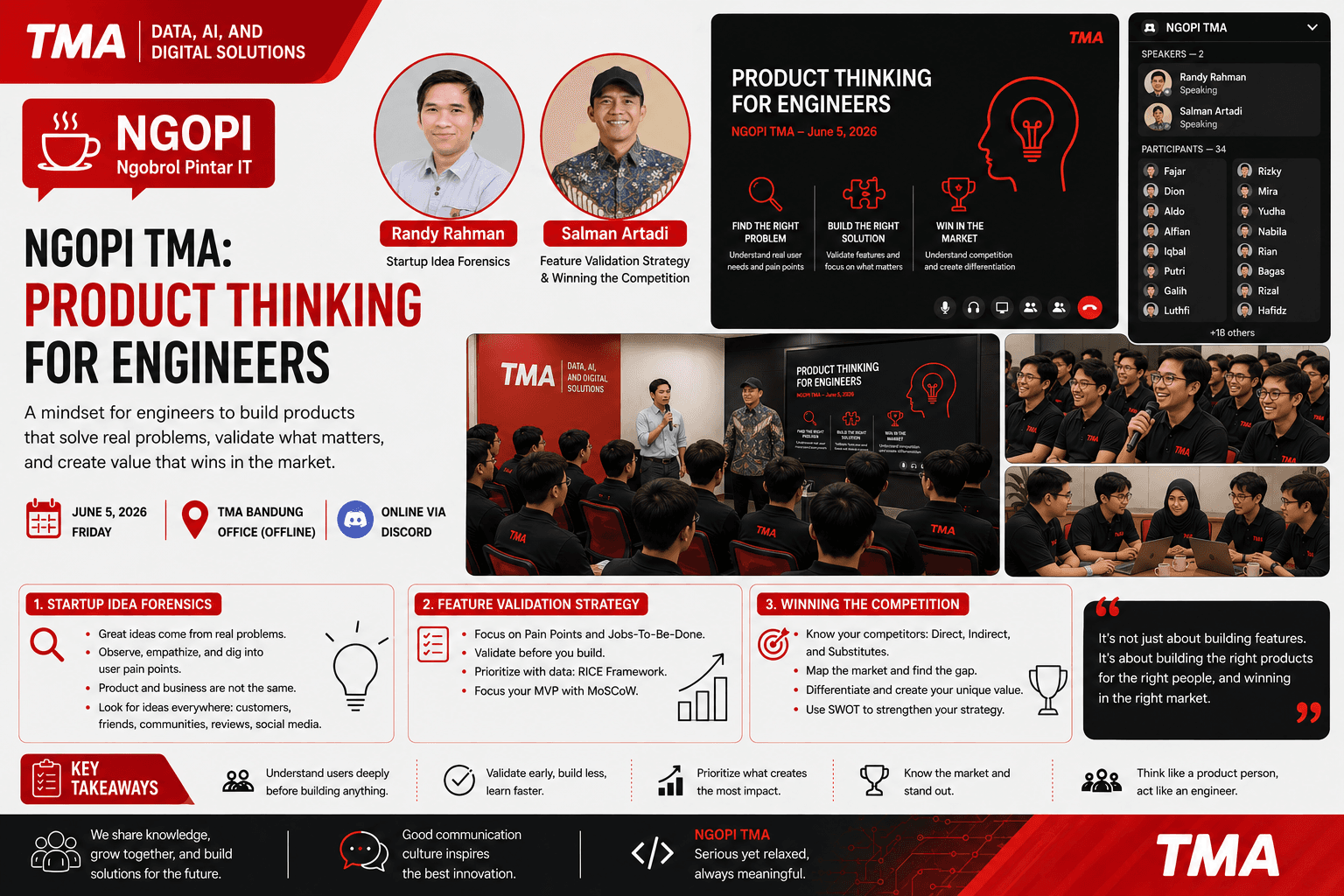
On June 5, 2026, TMA once again hosted its regular internal event, NGOPI (Ngobrol Pintar IT / Smart IT Talks), a knowledge-sharing forum that has become an integral part of the company’s learning and collaboration culture. This session was conducted in a hybrid format, both online through Discord and offline at the TMA Bandung office. This approach enabled all team members to participate actively, whether working remotely or attending in person.
Unlike previous sessions that focused heavily on technology and technical implementation, this edition of NGOPI explored a topic highly relevant to product and business development: “Product Thinking for Engineers.” The session was presented by two internal TMA speakers, Randy Rahman and Salman Artadi, who encouraged participants to view product development from a broader perspective than simply writing code or building features.
The first session was delivered by Randy Rahman through a presentation titled Startup Idea Forensics, which explored how great product ideas are actually born. From the beginning, Randy emphasized that successful ideas do not necessarily originate from revolutionary technology, but rather from a deep understanding of real-world problems faced by users. He highlighted that many successful startups were not built around technology first, but around identifying and solving everyday challenges experienced by people.
During his presentation, Randy shared examples of how major companies achieved success by addressing genuine customer pain points. Tokopedia helped users find trustworthy sellers, Traveloka simplified travel booking, and Halodoc made healthcare consultations more accessible. The same pattern could be observed across many successful startups: they started with problems, not technology.
The discussion then moved to an important concept: a product and a business are not the same thing. A product may solve a problem, but a successful business solves a problem for a large enough group of people who are willing to pay for that solution. Randy encouraged participants to evaluate product ideas from a market-needs perspective rather than solely through the lens of technical capabilities.
Interestingly, Randy also pointed out that the best product ideas often do not emerge from meeting rooms. Instead, valuable opportunities are usually found in customer complaints, conversations with colleagues and family members, community discussions, marketplace reviews, social media comments, and online forums. This message sparked lively discussions among participants about how engineering teams can become more connected to user needs.
The second session was led by Salman Artadi with a presentation titled Feature Validation Strategy. While Randy’s session focused on identifying worthwhile problems to solve, Salman explored how teams can determine which features are truly worth building. According to him, one of the most common mistakes in product development is becoming overly focused on feature ideas before validating whether users actually need them.
Salman explained the importance of starting with pain points and understanding the concept of Jobs-To-Be-Done (JTBD). Users do not buy products or features; rather, they “hire” solutions to accomplish specific tasks or solve particular problems. By understanding these fundamental needs, product teams can create solutions that deliver greater relevance and value.
One of the most engaging parts of the session was the discussion of various frameworks used to prioritize features. Salman introduced the RICE framework (Reach, Impact, Confidence, Effort) as a data-driven approach to prioritization. This methodology helps teams reduce subjective debates and focus on features that create measurable business impact.
Participants were also introduced to the MoSCoW framework (Must-have, Should-have, Could-have, Won’t-have), which helps teams distinguish between essential MVP features and enhancements that can be postponed to future iterations. This topic generated extensive discussion as many participants connected the framework to challenges they had experienced in past projects.
The final session, also delivered by Salman, focused on Winning the Competition, discussing how products should understand their position within a competitive market. Salman explained that analyzing competitors is not about copying them, but about understanding the market landscape in order to identify meaningful differentiation.
Participants learned about different categories of competitors, including direct competitors, indirect competitors, and substitute solutions, which can sometimes pose the greatest threat because they address the same underlying problem in different ways. One particularly interesting example illustrated how solutions from entirely different industries can become competitors when they fulfill the same customer need.
The discussion continued with techniques such as Competitive Landscape Analysis, Market Mapping, and Perceptual Mapping, which help organizations identify market gaps and underserved opportunities. Salman emphasized that many successful businesses do not necessarily create entirely new categories; instead, they discover and occupy spaces that existing competitors have failed to serve effectively.
As a concluding exercise, participants explored the use of SWOT Analysis (Strengths, Weaknesses, Opportunities, Threats) to objectively assess product positioning. The discussion became even more engaging as attendees began applying these concepts to products currently being developed within TMA.
As always, the atmosphere of NGOPI was highly interactive. Throughout the session, participants shared insightful and often humorous stories, ranging from experiences building features that users never adopted to lessons learned from engineers becoming attached to solutions before fully understanding the underlying problem. These lighthearted moments made the strategic content easier to absorb and more enjoyable to discuss.
Discord once again proved to be an effective collaboration platform. Online participants interacted seamlessly with those attending in person, sharing experiences, exchanging ideas, and asking questions in real time. There were no barriers between senior and junior engineers; everyone had equal opportunities to contribute and learn.
This edition of NGOPI demonstrated that modern engineers need more than technical expertise. They must also understand users, business models, market dynamics, and product strategy. By combining technical excellence with strong product thinking, engineers can contribute more effectively to creating solutions that not only function well but also deliver meaningful value to both customers and businesses.
NGOPI has evolved beyond being a technology-sharing forum. It has become a learning space where engineering, product, and business thinking come together in open, relaxed, and meaningful conversations. In an increasingly competitive industry, this mindset will play a critical role in helping TMA build products that are relevant, innovative, and sustainable for the future.