TMA NGOPI: Exploring the Era of Agentic AI with n8n — From Chatbots to Autonomous Intelligent Agents
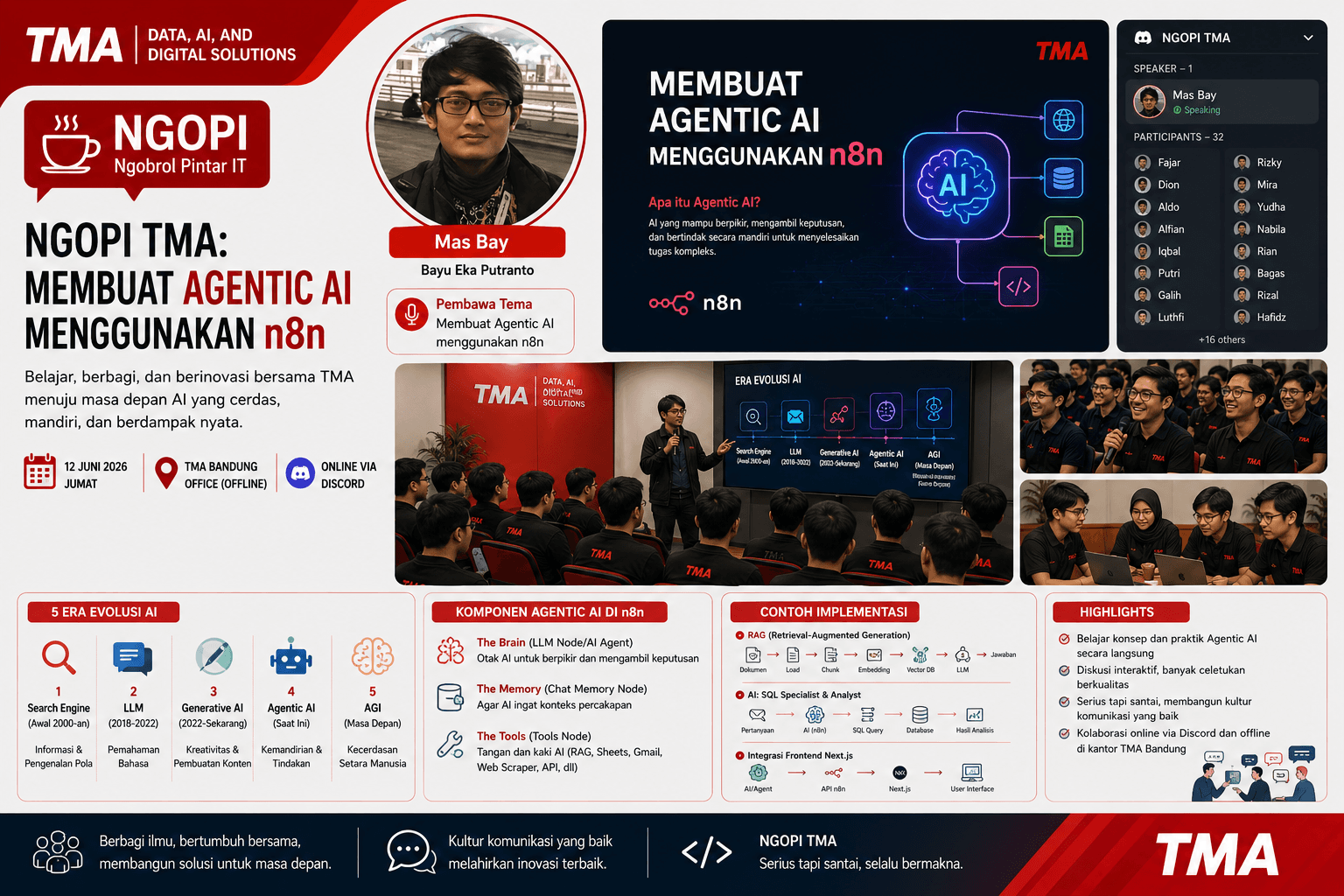
On June 12, 2026, TMA once again hosted its regular internal event, NGOPI (Ngobrol Pintar IT / Smart IT Talks), a knowledge-sharing forum that has become an essential part of the company’s learning and collaboration culture. This session was conducted in a hybrid format, both online through Discord and offline at the TMA Bandung office. As always, the combination of these two formats enabled all team members to participate actively regardless of their location, while further strengthening the flexible work culture that TMA continues to promote.
For this edition, Bayu Eka Putranto, widely known as Mas Bay, served as the featured speaker, presenting a highly relevant topic in today’s technology landscape: “Building Agentic AI Using n8n.” The session provided participants with insights into how artificial intelligence has evolved from being merely an information retrieval tool into an intelligent agent capable of making decisions and executing tasks autonomously.
From the very beginning, the atmosphere was lively and engaging. Mas Bay delivered the material in a relaxed, practical, and highly interactive manner. Between technical explanations, participants contributed insightful jokes and spontaneous comments that kept the discussion enjoyable. Despite the casual environment, the conversation remained deep and informative. This balance between technical depth and relaxed interaction has become one of the defining characteristics of NGOPI and a key reason why it continues to be eagerly anticipated by the TMA team.
Mas Bay opened the session by explaining the fundamental concept of artificial intelligence. He described AI as an effort to train machines to emulate human thinking capabilities, ranging from language understanding to problem-solving. While traditional AI systems relied heavily on explicitly programmed instructions, modern AI can understand context and even anticipate user needs without requiring detailed guidance.
One of the most interesting parts of the presentation was the exploration of AI’s evolution over time. Mas Bay explained how the first major wave of modern AI was represented by search engines, which focused on indexing information and matching keywords. At this stage, systems were primarily reactive and lacked a true understanding of the meaning behind users’ queries.
The discussion then moved into the era of Large Language Models (LLMs), where AI began to understand human language in a far more sophisticated way thanks to the development of Transformer architectures. At this stage, AI was no longer limited to finding information—it could summarize, interpret, and generate responses based on context.
Mas Bay also discussed the explosive growth of Generative AI, which has become an integral part of modern digital life. With platforms such as ChatGPT, Midjourney, and DALL-E, AI systems are now capable of generating entirely new content, including text, images, software code, and even videos, all based on simple user instructions.
However, the core focus of the session was the concept of Agentic AI, which Mas Bay described as the next major evolution in artificial intelligence. Unlike traditional chatbots that simply answer questions, Agentic AI can independently perform complex tasks. If a user asks an AI agent to conduct market research or prepare a business report, the agent can break the request into smaller tasks, gather information, use external tools, and complete the objective with minimal supervision.
According to Mas Bay, this represents a significant shift in the AI industry. The goal is no longer just to create models that can answer questions intelligently, but to develop agents that can think, make decisions, and take actions to achieve specific objectives.
To demonstrate how Agentic AI can be implemented in practice, Mas Bay introduced n8n, a powerful workflow automation platform that enables organizations to connect AI models, databases, APIs, and business applications into intelligent automated workflows. He explained that n8n provides a flexible environment where AI agents can orchestrate multiple systems and services to accomplish real-world tasks.
Participants were then introduced to the three fundamental building blocks of an Agentic AI system built with n8n.
The first component is The Brain, which represents the AI model or LLM responsible for reasoning and decision-making. Depending on the implementation, organizations can utilize models from OpenAI, Anthropic, Ollama, or even proprietary enterprise AI platforms such as AiTMA.
The second component is The Memory, which allows AI agents to retain context and conversation history. This capability enables more natural interactions and improves the agent’s ability to perform multi-step tasks that require continuity and contextual understanding.
The third component is The Tools, which consist of external capabilities that AI agents can invoke to complete tasks. Examples include Retrieval-Augmented Generation (RAG), Google Sheets, Gmail, web scrapers, APIs, databases, and countless other integrations. These tools transform AI from a passive conversational interface into an active digital worker capable of interacting with real systems.
The session became even more engaging when Mas Bay demonstrated a practical implementation of Retrieval-Augmented Generation (RAG) using n8n. Participants observed how documents could be processed, converted into embeddings, stored within a vector database, and subsequently used as trusted knowledge sources for AI-generated responses. The workflow diagrams clearly illustrated how various n8n nodes collaborate to create an integrated and intelligent AI system.
Another highlight of the session was the demonstration of an AI SQL Specialist & Analyst, an intelligent agent capable of translating natural language questions into SQL queries, executing those queries against a database, and automatically presenting analytical insights. This example captured significant attention because it showcased how AI can democratize data analysis by reducing the need for advanced SQL expertise.
Toward the end of the presentation, Mas Bay demonstrated how Agentic AI solutions can be integrated with modern frontend frameworks such as Next.js, creating applications that are not only intelligent on the backend but also highly accessible and user-friendly through modern web interfaces.
As with previous NGOPI sessions, the discussion was highly interactive. Participants raised questions about vector databases, LLM implementation costs, data security, governance considerations, and potential applications of Agentic AI within TMA’s growing ecosystem of products, including AiTMA, TeMA Data Platform, and TeMA News Analytics. Several attendees also began brainstorming ways AI agents could automate internal processes that currently require manual effort.
Discord once again proved to be an effective platform for collaboration and discussion. Online and onsite participants interacted seamlessly, sharing screens, exchanging ideas, discussing technical challenges, and engaging in real-time brainstorming sessions. The open communication culture that TMA has cultivated over the years was clearly evident throughout the event.
Through this session, TMA reaffirmed its commitment to staying at the forefront of technological innovation while continuously developing internal expertise that aligns with future industry demands. Agentic AI is no longer a futuristic concept—it is becoming a practical technology that organizations can implement today to work smarter, faster, and more efficiently.
This edition of NGOPI provided more than just technical knowledge about Agentic AI and n8n. It offered a glimpse into the future of artificial intelligence—a future where AI is no longer merely a tool, but a digital collaborator capable of thinking, acting, and working alongside humans to solve increasingly complex business and technological challenges.