TMA NGOPI Discusses Frappe Framework: The Secret Weapon Behind ERPNext
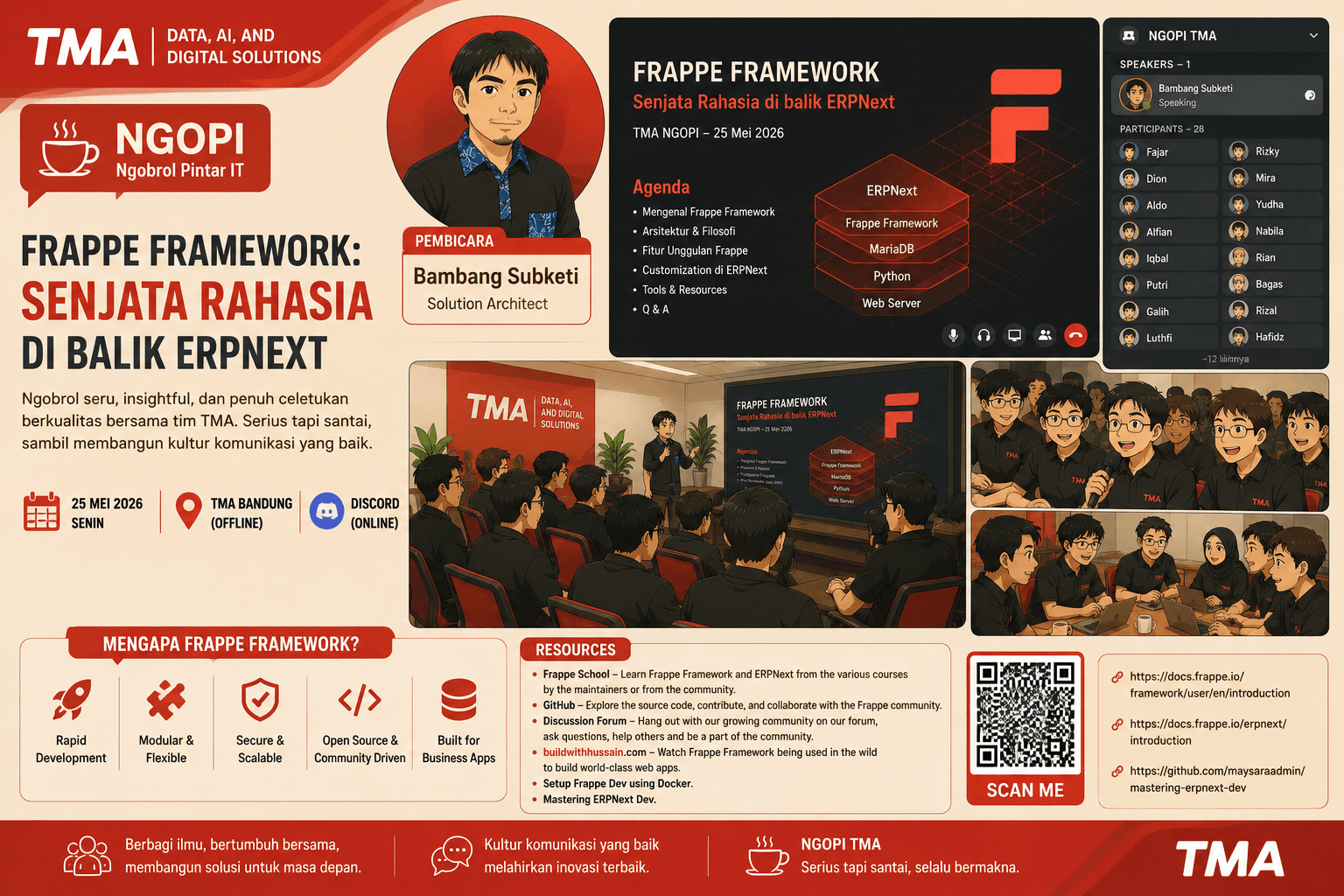
On May 25, 2026, TMA once again held its regular internal event titled NGOPI (Ngobrol Pintar IT / Smart IT Talks), a technology discussion forum that has become an important part of the company’s learning and collaboration culture. This session was conducted in a hybrid format, both online through Discord and offline at the TMA Bandung office. Through this format, all team members were able to participate regardless of their working location, reflecting the flexible work culture continuously fostered at TMA.
The main topic of this NGOPI session was presented by Bambang Subketi, who delivered an engaging discussion titled “Frappe Framework: The Secret Weapon Behind ERPNext.” The topic attracted significant attention because ERPNext itself has become one of the most widely used open-source ERP platforms across various industries, while the Frappe Framework often remains less recognized despite being the core foundation behind ERPNext’s flexibility and strength.
From the very beginning, the atmosphere of the event felt lively and engaging. Bambang opened the discussion with a relaxed yet highly technical approach, making complex concepts easier to understand. Lighthearted jokes and spontaneous comments from both participants and speakers kept the forum dynamic while remaining insightful. The “serious yet relaxed” culture that has become a trademark of NGOPI was once again strongly reflected throughout the session.
In his presentation, Bambang explained that many developers know ERPNext as a ready-to-use ERP application, but not everyone realizes that behind ERPNext lies a highly powerful framework called Frappe Framework. This framework is not merely a standard backend system, but a full-stack web framework that enables business application development to be fast, modular, and scalable.
The discussion then moved toward the core philosophy of the Frappe Framework, which emphasizes simplified enterprise application development through a metadata-driven architecture. With this approach, many development processes can be completed much faster compared to conventional frameworks because developers do not need to build everything from scratch.
Bambang also explained how Frappe enables developers to build systems using a flexible document-oriented model suitable for various business needs. This flexibility is one of the key reasons why ERPNext has evolved into a highly adaptive ERP platform capable of supporting different industries and business processes.
The materials presented during the session referred to various official Frappe learning resources, including framework documentation and ERPNext references available on the official Frappe website. In addition, participants were introduced to several important resources such as:
- Frappe School as the official learning platform
- The Frappe GitHub Repository for source code exploration
- The Frappe Community Forum for technical discussions
- Various references related to modern ERPNext development
One of the most interesting topics discussed was how developers can build custom applications on top of ERPNext using the Frappe Framework without directly modifying the core system. This approach allows system maintenance and upgrades to become much safer and more sustainable.
In addition, Bambang discussed how modern development workflows in Frappe have become easier through the use of Docker for environment setup. One of the highlighted resources was the process of setting up Frappe Development using Docker, helping developers build development environments more consistently and efficiently.
The discussion became even more engaging when participants began sharing experiences regarding ERP implementation and real-world customization challenges. Many attendees talked about how traditional frameworks often complicate enterprise application development because they are too rigid or require significant effort for customization.
Within this context, Frappe was considered to have a unique approach because it successfully bridges both low-code and full-code development needs. Developers can take advantage of built-in framework features to accelerate development while still maintaining high flexibility for implementing custom logic whenever needed.
The NGOPI session did not focus solely on technical discussions. It also highlighted the importance of open-source culture in modern technology development. Bambang emphasized that the strength of Frappe and ERPNext comes not only from the technology itself but also from the global community actively sharing knowledge, source code, and implementation solutions.
The discussion around community culture became one of the most vibrant parts of the event. Many participants pointed out how open-source culture closely resembles TMA’s internal culture, which encourages knowledge sharing, open collaboration, and continuous learning.
Discord, used as the online collaboration platform, once again demonstrated its effectiveness in supporting flexible technical communication. Online participants were able to ask questions directly through voice channels and chat without formal barriers. Some onsite and remote participants even engaged in live troubleshooting sessions and development experience sharing throughout the event.
The session became even more exciting when participants started sharing humorous stories about ERP debugging experiences, dependency conflicts, and the infamous “migration drama” often faced by developers. Although delivered humorously, these conversations enriched the discussion because they were based on real-world experiences highly relevant to other participants.
Behind the relaxed atmosphere, NGOPI once again proved its role as a healthy communication space within TMA. There were no barriers between senior and junior engineers, no hesitation to ask questions, and every participant had the opportunity to share perspectives. This environment serves as a crucial foundation for building a strong engineering culture that remains adaptive to technological developments.
Beyond improving technical knowledge, the event also reflected TMA’s growing commitment to building enterprise platform capabilities based on open-source technologies. By gaining a deeper understanding of the Frappe Framework, internal teams are expected to develop ERP and business application solutions that are more flexible, scalable, and aligned with market needs.
Toward the end of the session, many participants expressed strong interest in exploring the Frappe Framework further, including its potential use in developing future internal TMA products. Discussions continued casually even after the main session had officially ended, demonstrating the high enthusiasm among participants.
Through NGOPI, TMA once again demonstrated that learning technology does not have to take place in rigid or overly formal environments. With a more open, relaxed, and collaborative approach, knowledge sharing becomes significantly more engaging and effective.
NGOPI is more than just a technology discussion forum. It has evolved into a symbol of TMA’s culture—a culture that believes innovation is born from healthy communication, strong curiosity, and an endless spirit of learning together.