Mobile Programming Workshop
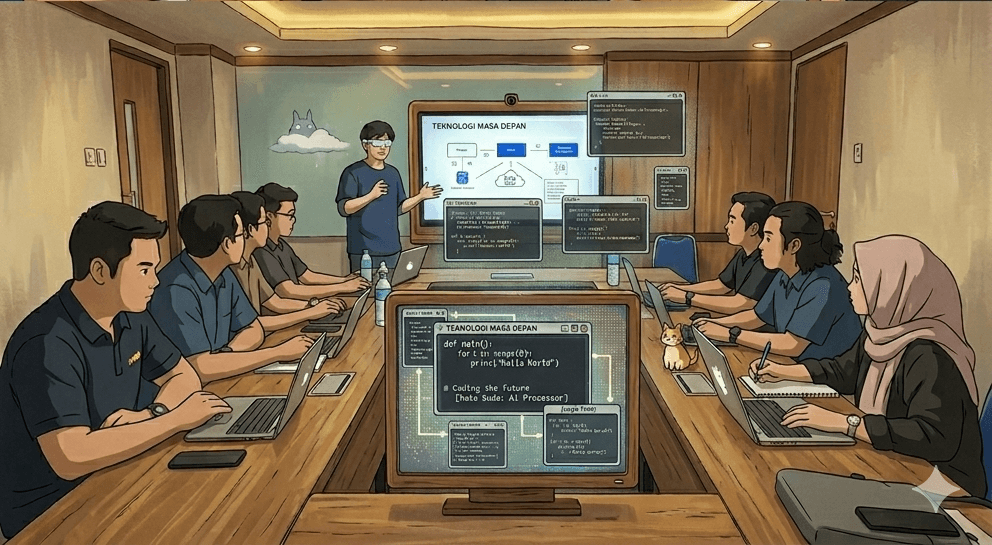
Bandung, April 9, 2026 — PT Tech Mayantara Asia (TMA) once again demonstrated its commitment to enhancing the technical capabilities of its team by organizing a mobile programming workshop at its Bandung office. The event featured Varyl, a software engineer at TMA, as the main speaker, who shared in-depth insights into modern mobile application development technologies.
The workshop was attended by developers and technical teams within TMA, focusing on understanding and comparing three popular technologies in mobile application development: Flutter, FlutterFlow, and React Native. In his presentation, Varyl emphasized that technology selection cannot be one-size-fits-all, but must be aligned with business needs, development strategy, and team readiness.
Varyl began the session by explaining the fundamental differences between the three technologies, starting with the programming languages they use. Flutter and FlutterFlow both utilize Dart, while React Native uses JavaScript or TypeScript. He highlighted that the choice of programming language significantly impacts the team’s learning curve and adaptation speed during development.
In terms of development approach, Flutter and React Native are typically used with full coding practices, offering high flexibility for building complex applications. Meanwhile, FlutterFlow provides a low-code, drag-and-drop approach that allows applications to be developed quickly without requiring deep programming expertise.
Varyl also discussed state management, a critical component in application development. Flutter uses approaches such as Riverpod, Provider, or BLoC, which are generally structured across separate files. On the other hand, React Native utilizes hooks like useState and useEffect, which are simpler yet powerful.
In one of the more engaging sessions, Varyl outlined the strengths and weaknesses of each technology in terms of performance, scalability, and collaboration. Flutter is known for its high performance due to its own rendering engine, enabling smooth animations. React Native stands out for its extensive ecosystem and ease of integration, while FlutterFlow excels in rapid development, especially for building Minimum Viable Products (MVPs).
However, he also highlighted certain limitations, particularly with FlutterFlow, which is considered less flexible for large-scale development. In some cases, the generated code from FlutterFlow can become complex and difficult to maintain, often requiring a complete rebuild for enterprise-level applications.
Beyond the current landscape, Varyl also presented future technology roadmaps. Flutter continues to evolve with improvements in graphical performance and WebAssembly support. React Native is advancing through its new architecture, including Fabric and TurboModules, while FlutterFlow is beginning to integrate AI technologies to accelerate application design.
From a business strategy perspective, Varyl emphasized the importance of understanding the primary goals of application development. For rapid go-to-market needs, FlutterFlow can be an attractive option. However, for long-term development and large-scale applications, Flutter and React Native are considered more suitable due to their flexibility and scalability.
The workshop was conducted interactively, with active discussions and Q&A sessions from participants. Many attendees showed strong interest in exploring real-world implementations of each technology, particularly in relation to TMA’s diverse client requirements.
This event is part of TMA’s ongoing effort to foster a continuous learning culture within the organization. By hosting internal knowledge-sharing sessions led by engineers like Varyl, TMA not only strengthens technical competencies but also encourages collaboration and innovation in developing digital solutions.
Through this workshop, TMA hopes that all team members will gain a more comprehensive understanding of technology selection, enabling them to build products that are not only developed quickly but are also high-quality and sustainable in the long term.