Building a Culture of Growth: How TMA Puts People at the Center of Innovation
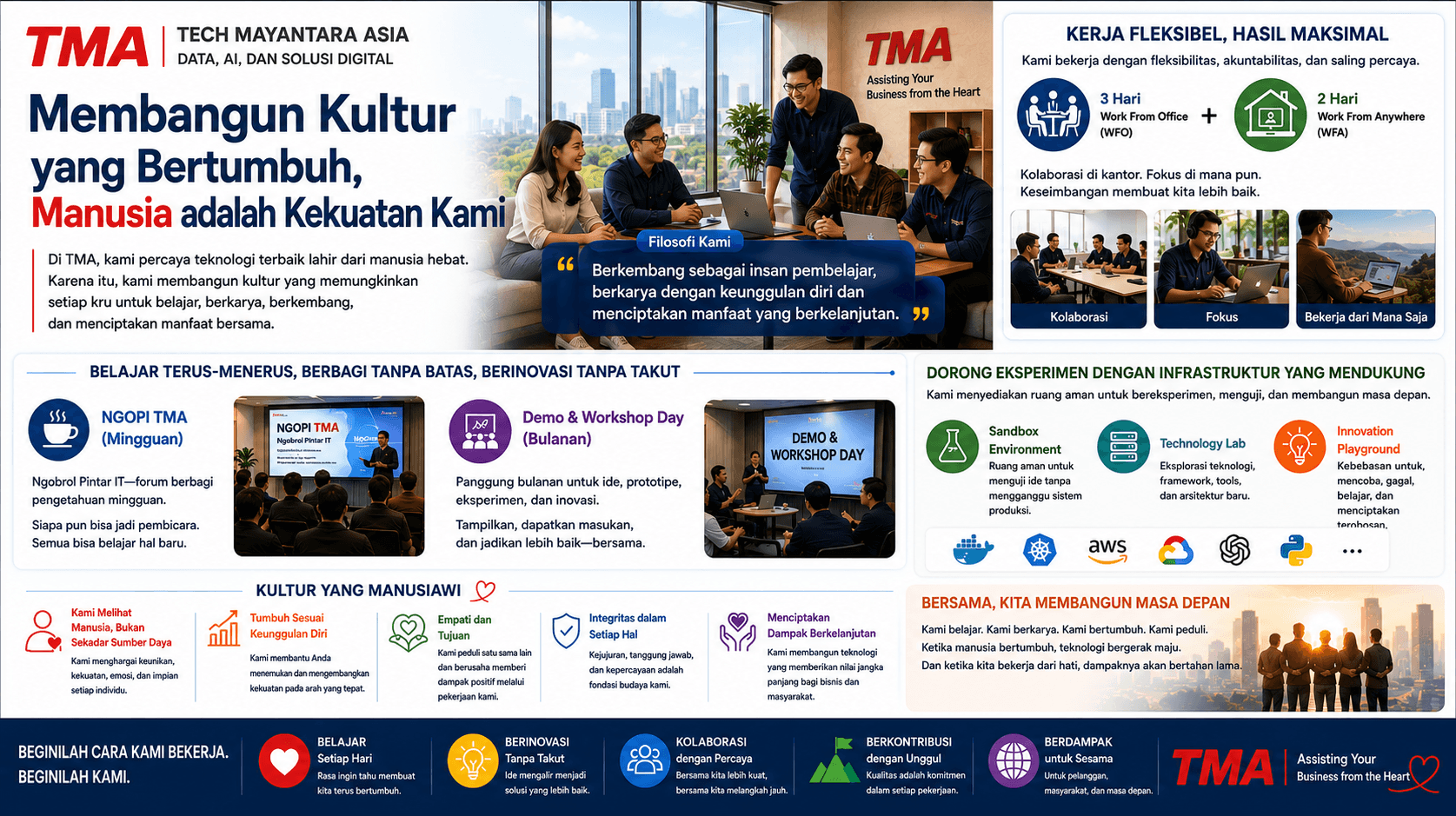
In today’s rapidly evolving digital landscape, many companies compete by developing cutting-edge technologies, launching innovative products, and maximizing operational efficiency. However, PT Tech Mayantara Asia (TMA) believes that the true strength of an organization lies not only in the sophistication of its technology but, more importantly, in the quality of the people who create and continuously improve it. This belief has shaped TMA into a company where organizational culture serves as the foundation for sustainable growth.
At TMA, the workplace is much more than an office—it is a place to learn, create, grow, and discover one’s full potential. This philosophy is reflected in the company’s guiding principle:
"Growing as lifelong learners, creating through our unique strengths, and delivering sustainable value."
This philosophy influences every aspect of TMA, from organizational management and product development to team collaboration and customer engagement. Every company policy is designed not only to improve productivity but also to ensure that every individual has the opportunity to grow professionally while developing as a complete human being.
One of the most tangible expressions of this philosophy is TMA’s flexible working culture. From the very beginning, the company recognized that creativity and innovation are not confined to office walls. Great ideas can emerge anywhere, provided there is accountability, commitment, and a strong sense of ownership.
To support this belief, TMA adopts a 3-day Work From Office (WFO) and 2-day Work From Anywhere (WFA) schedule each week. This arrangement gives every team member the flexibility to organize their work in ways that best suit their individual working style and personal circumstances.
During office days, employees collaborate through face-to-face discussions, technical workshops, architecture reviews, mentoring sessions, and product brainstorming. On WFA days, they are free to work from home, coworking spaces, cafés, or any environment that allows them to remain productive while maintaining a healthy work-life balance.
This flexibility does not reduce discipline or accountability. On the contrary, it is built upon mutual trust and ownership. At TMA, professionalism is measured not by how many hours someone spends at their desk, but by the quality of their contributions, the value they create, and the commitment they demonstrate toward the team and customers.
Learning is perhaps the most deeply rooted aspect of TMA's culture. In the technology industry, today's expertise can quickly become outdated tomorrow. Continuous learning is therefore not considered optional—it is an essential part of professional life.
To cultivate this mindset, TMA organizes NGOPI TMA (Ngobrol Pintar IT) every week. Over time, this knowledge-sharing forum has become one of the company's most anticipated traditions.
NGOPI provides an open platform where anyone can become a speaker. Team members share project experiences, introduce emerging technologies, discuss software architecture, artificial intelligence, DevOps, data engineering, ERP systems, cybersecurity, cloud computing, and even lessons learned from project failures.
What makes NGOPI unique is its atmosphere. Rather than being a formal seminar, it is designed to be relaxed, interactive, and enjoyable while maintaining deep technical discussions. There are no barriers between senior and junior engineers. Everyone is encouraged to ask questions, exchange ideas, challenge assumptions, and contribute their own perspectives.
Many innovative ideas, technical approaches, and even future product concepts have emerged naturally from these informal conversations.
Beyond weekly knowledge sharing, TMA also nurtures creativity through its monthly Demo & Workshop Day.
While NGOPI focuses on learning and discussion, Demo & Workshop Day is dedicated to showcasing innovation.
During this monthly event, teams present prototypes, proof-of-concepts, experimental applications, new product ideas, technical research, and ongoing developments. Not every demonstration is intended to become a commercial product. Instead, the event celebrates curiosity, experimentation, and the willingness to explore new possibilities.
This initiative creates an environment where employees feel safe to innovate, experiment, and even fail without fear of criticism.
At TMA, innovation is not driven by pressure—it is driven by psychological safety.
To support this culture of experimentation, the company invests in dedicated infrastructure, including sandbox environments, technology laboratories, and innovation playgrounds.
These environments allow engineers to safely explore new frameworks, cloud-native technologies, artificial intelligence models, data lakehouse architectures, container platforms, and open-source ecosystems without affecting production systems.
Software engineers can evaluate new development frameworks.
AI engineers can experiment with the latest language models.
Platform engineers can prototype modern infrastructure architectures.
Data engineers can validate new analytical pipelines.
Everything happens within an environment specifically designed for exploration and learning.
TMA considers experimentation an investment in the future. While not every experiment produces immediate business value, every experiment generates new knowledge that strengthens the organization's capabilities.
Perhaps what most distinguishes TMA from many technology companies is how it views people.
At TMA, employees are not regarded merely as "resources" or "headcount." They are individuals with unique talents, aspirations, emotions, families, dreams, and immense potential.
Consequently, the company strives to create a genuinely human-centered workplace where everyone is encouraged to contribute according to their natural strengths rather than conforming to a single standard.
Every individual possesses different talents.
Some excel in designing scalable system architectures.
Others are exceptional communicators.
Some naturally lead teams.
Others possess extraordinary analytical skills, creativity, or attention to detail.
The company's responsibility is to help individuals discover those strengths, nurture them, and position them where they can make the greatest impact.
This philosophy is currently being reinforced through structured competency mapping and talent development initiatives aimed at aligning personal strengths with organizational needs.
The objective is not merely organizational efficiency but personal fulfillment—allowing every employee to grow according to their own capabilities, interests, and aspirations.
Beyond professional development, TMA also recognizes that human beings are not solely intellectual creatures.
People possess emotional, moral, and spiritual dimensions.
Everyone carries values, beliefs, compassion, and an innate desire to contribute positively to others.
The company therefore seeks to foster an environment that respects these dimensions, making work more than simply earning a living. It becomes an opportunity to create meaningful impact for colleagues, customers, and society.
From TMA's perspective, technology is simply a tool.
Human beings determine how that technology is used.
For this reason, character, integrity, empathy, responsibility, and humility are considered just as important as technical expertise.
This philosophy also shapes how TMA defines success.
Success is not measured solely by completed projects, revenue growth, or the number of products launched.
It is equally measured by how many people continue to grow.
How much knowledge is shared.
How much innovation is created.
How much value is delivered to customers, partners, and society.
This mindset aligns perfectly with TMA's corporate tagline:
"Assisting Your Business from the Heart."
Serving from the heart is not directed only toward customers.
It also defines how the company treats its own people.
When individuals are given opportunities to learn, experiment, innovate, and develop according to their strengths, they naturally produce better solutions, stronger products, and more meaningful customer experiences.
Ultimately, TMA believes that truly great companies are not those possessing the most advanced technologies.
They are organizations that continuously develop people who never stop learning, never stop growing, and never stop creating lasting value.
With this cultural foundation, TMA aspires to remain a true learning organization—where innovation is fueled by curiosity, collaboration is strengthened by trust, and success is achieved not only through intelligence but also through compassion.
Because when people grow, technology evolves with them.
And when people work with heart, the value they create becomes sustainable—for customers, for society, and for future generations.