NGOPI IT Explores FastAPI Fundamentals: Building Modern, High-Performance APIs Ready for the AI Era
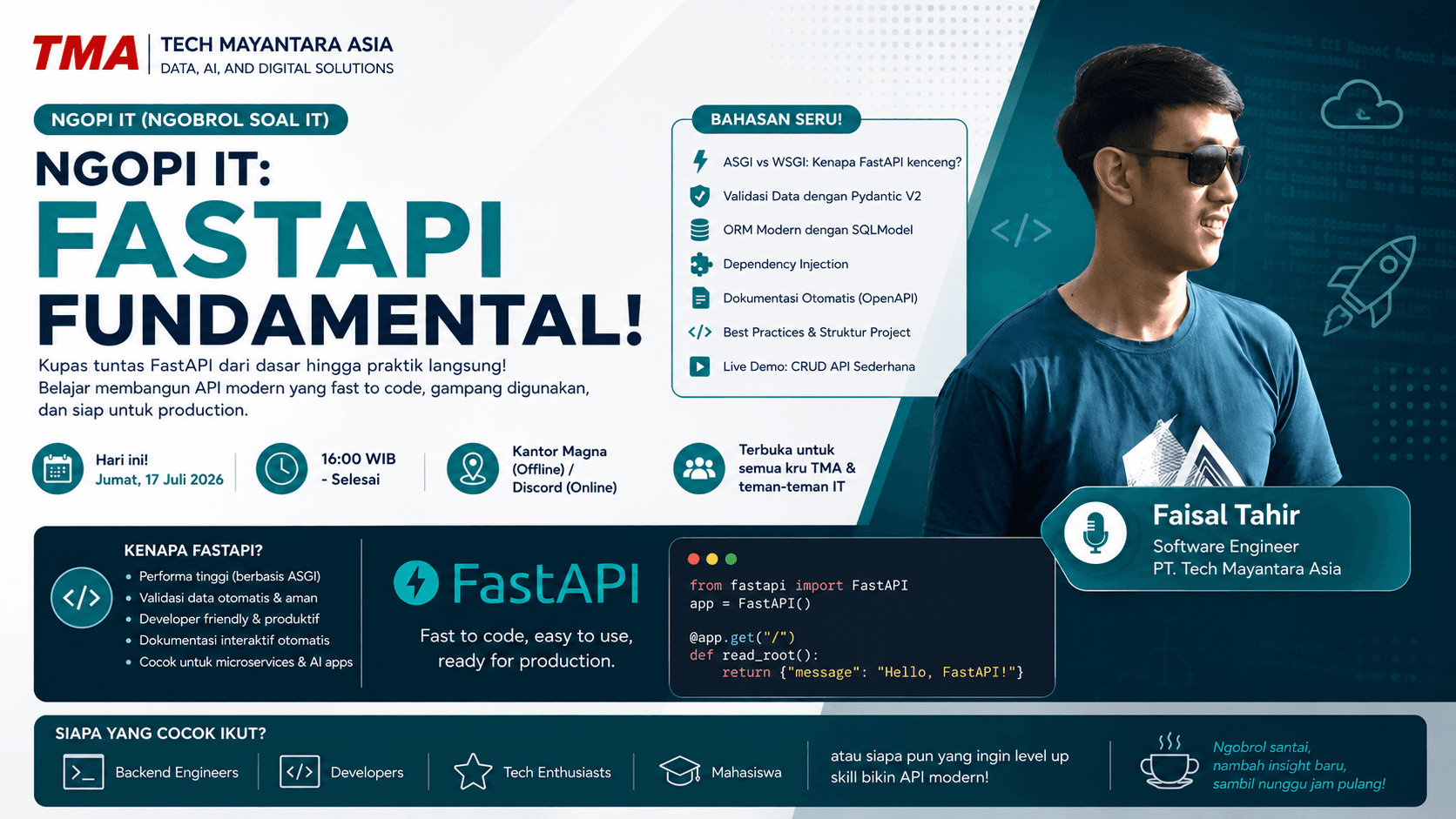
The spirit of continuous learning and knowledge sharing once again came alive at PT Tech Mayantara Asia (TMA) through another edition of its regular NGOPI IT (Ngobrol Pintar IT) knowledge-sharing session. Held on Friday, July 17, 2026, the event brought together TMA crew members in a hybrid format, with participants joining onsite at the Magna Office and online via Discord, enabling engineers from different locations to learn together without geographical barriers.
This session featured "FastAPI Fundamentals", presented by Faisal Tahir, who guided participants through one of today's most popular Python frameworks for developing modern backend applications. The presentation covered everything from the basic concepts to practical implementation, making it valuable for both beginners and experienced software engineers.
From the opening minutes, the atmosphere reflected the signature NGOPI IT style—relaxed, interactive, and intellectually engaging. Rather than being a one-way lecture, the session evolved into an open discussion where participants shared real-world experiences, exchanged ideas, and explored practical challenges encountered while building backend systems. This informal yet insightful environment has become one of the defining characteristics of TMA's engineering culture, where learning is encouraged through conversation and collaboration.
Faisal began by introducing FastAPI and explaining why it has become one of the fastest-growing backend frameworks in the Python ecosystem. He described FastAPI as a modern web framework designed to deliver exceptional performance while maximizing developer productivity and ensuring strong data validation. Built upon Starlette for web functionality and Pydantic for data validation, FastAPI combines speed, reliability, and clean architecture into a single development platform.
One of the highlights of the session was the discussion on why FastAPI has become the preferred framework for building microservices, REST APIs, and increasingly, AI-powered applications. Faisal explained that its native support for asynchronous programming using async/await allows applications to process multiple requests simultaneously with outstanding efficiency, making it particularly suitable for today's cloud-native and distributed architectures.
The audience showed great interest during the explanation of ASGI versus WSGI. Using a simple restaurant waiter analogy, Faisal illustrated how asynchronous execution enables servers to continue serving other requests while waiting for external operations such as database queries, third-party APIs, or AI inference services. This comparison helped participants understand one of the fundamental reasons behind FastAPI's remarkable performance advantages.
The discussion then shifted toward FastAPI's core strengths. Participants learned how built-in Dependency Injection, automatic OpenAPI documentation, and seamless Pydantic V2 integration significantly reduce development effort while improving application reliability. Instead of spending time writing repetitive boilerplate code, developers can focus on implementing business logic while the framework automatically handles validation, documentation, and many infrastructure concerns.
To demonstrate FastAPI's simplicity, Faisal conducted a live coding session showing how to build a functional API using only a few lines of Python code. Participants followed the complete process, from installing the required packages with pip, creating the first main.py application, launching the development server with Uvicorn, and finally exploring the automatically generated Swagger UI documentation. For many attendees, this feature alone illustrated how FastAPI dramatically accelerates backend development while simplifying API testing and collaboration between backend and frontend teams.
The presentation continued with an in-depth explanation of Pydantic V2, FastAPI's powerful validation engine. Faisal demonstrated how incoming JSON requests are automatically validated according to predefined Python type hints before reaching the application logic. Invalid requests immediately return informative HTTP error responses without requiring developers to manually implement validation logic. This automated validation not only improves API consistency but also significantly reduces the possibility of runtime errors.
Another topic that generated considerable interest was SQLModel, a modern Object-Relational Mapping (ORM) library that combines the strengths of SQLAlchemy and Pydantic. Faisal explained how SQLModel eliminates redundant code by allowing developers to define a single model that serves both as the API schema and the database representation. This unified approach improves maintainability, reduces duplication, and accelerates enterprise application development.
Given TMA's growing investment in Artificial Intelligence solutions, the session naturally progressed into the role of FastAPI within modern AI architectures. Faisal illustrated how FastAPI integrates seamlessly with AI Agents, Retrieval-Augmented Generation (RAG) pipelines, external Web Search services, and Large Language Models (LLMs). Thanks to its asynchronous architecture, FastAPI can efficiently orchestrate multiple AI services without blocking incoming user requests, making it an ideal backend framework for intelligent applications.
Participants also explored advanced optimization strategies commonly used in production-grade AI systems. Topics included lifespan model caching, background task execution, and thread pool management for CPU-intensive workloads. These architectural techniques are increasingly relevant as TMA continues to develop intelligent digital platforms, including the expanding AiTMA ecosystem, which relies heavily on AI orchestration and scalable backend services.
One of the most engaging moments came during the open discussion comparing FastAPI with other popular Python frameworks such as Flask and Django. Faisal emphasized that while every framework has its strengths, FastAPI particularly excels in building high-performance REST APIs, microservices, mobile application backends, and AI platforms. The comparison covered execution speed, asynchronous capabilities, automatic documentation, data validation, and scalability, giving participants a clearer understanding of when FastAPI is the most appropriate technology choice.
Throughout the session, technical discussions were interspersed with humor and real-life development stories. Participants shared their first experiences learning asynchronous programming, debugging API endpoints, and discovering that a simple type mismatch could trigger unexpected validation errors. These conversations made the learning experience both practical and enjoyable, reinforcing the collaborative spirit that defines every NGOPI IT session.
Discord once again proved to be an effective collaboration platform, enabling remote participants to ask questions and actively contribute to discussions alongside colleagues attending in person. This hybrid learning model aligns perfectly with TMA's flexible working culture, ensuring that continuous learning remains accessible regardless of where team members are working.
Beyond introducing another modern technology stack, the FastAPI Fundamentals session highlighted a broader message about the future of software engineering. As Artificial Intelligence, cloud computing, and distributed microservices continue to reshape the technology landscape, building secure, scalable, high-performance backend systems is becoming an essential capability for every software engineer. FastAPI provides an elegant foundation for developing exactly those kinds of systems.
By the end of the session, many participants expressed enthusiasm about adopting FastAPI in upcoming internal projects, ranging from enterprise integrations and web applications to mobile backends and AI-powered platforms. The practical demonstrations clearly showed that building modern APIs no longer requires complex configurations or extensive boilerplate code, allowing development teams to deliver high-quality software more efficiently.
Through its ongoing NGOPI IT initiative, TMA continues to demonstrate its commitment to fostering a culture of continuous learning, knowledge sharing, and engineering excellence. More than just a technical seminar, NGOPI IT serves as a collaborative forum where engineers exchange ideas, strengthen professional relationships, and collectively explore emerging technologies. By nurturing curiosity, encouraging open discussion, and embracing lifelong learning, TMA continues to cultivate an engineering culture capable of driving innovation and creating meaningful impact for customers, partners, and society.