TMA NGOPI Discusses ERPNext/Frappe as a Backend API: Building Fast, Secure, and Flexible Application Integrations
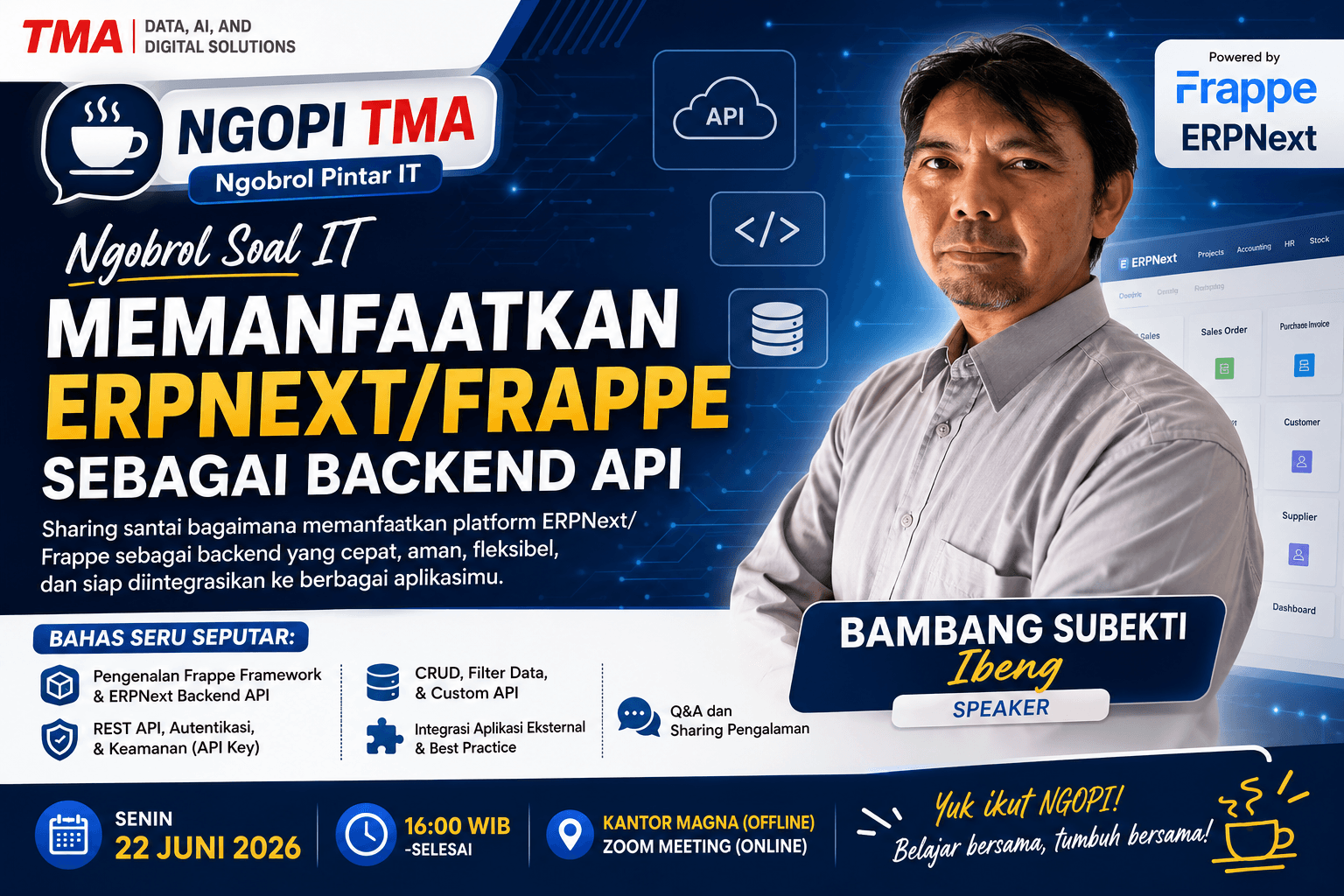
Bandung, June 22, 2026 — The spirit of knowledge sharing and fostering a strong engineering culture was once again evident during NGOPI (Ngobrol Pintar IT), a regular internal knowledge-sharing session organized by PT Tech Mayantara Asia (TMA). This edition featured a highly relevant topic for modern software development: “Leveraging ERPNext/Frappe as a Backend API.”
Held on Monday, June 22, 2026, starting at 4:00 PM WIB, the event adopted a hybrid format, combining an offline session at the Magna Office in Bandung with online participation via Zoom Meeting. This arrangement enabled team members from various locations to join seamlessly, reflecting TMA’s commitment to flexibility, collaboration, and equal access to learning opportunities.
The session was led by Bambang Subekti, affectionately known as Ibeng, who is widely recognized within TMA for his extensive experience in developing enterprise solutions based on ERPNext and the Frappe Framework. With his characteristic blend of technical depth and approachable storytelling, Ibeng transformed what could have been a complex topic into an engaging and highly practical discussion.
From the very beginning, the atmosphere was lively and interactive. Participants exchanged jokes about deployment mishaps, API authentication headaches, and the never-ending adventures of debugging production systems. As with every NGOPI session, the discussion maintained the perfect balance between professionalism and camaraderie—serious in substance, yet relaxed in delivery.
The presentation was based on a comprehensive blueprint of the Frappe REST API architecture, demonstrating how the Frappe Framework provides powerful API capabilities with virtually no additional configuration required. One of the key points highlighted during the session was Frappe’s ability to automatically generate REST API endpoints for every DocType available within the system. This allows developers to create backend services rapidly without having to write boilerplate API code from scratch.
According to Ibeng, many developers view ERPNext primarily as a ready-to-use ERP application, while overlooking the powerful framework that powers it underneath. The Frappe Framework itself can serve as a robust backend platform for a wide range of business applications. Through standard endpoints such as /api/resource/<doctype>, developers can immediately perform CRUD operations on data without building additional controllers or service layers.
One of the most engaging parts of the session focused on authentication mechanisms. Participants learned that Frappe supports multiple authentication methods, including session-based authentication, OAuth 2.0, and token-based authentication. For server-to-server integrations, token-based authentication is generally recommended because it offers both simplicity and security. This approach utilizes an API Key and API Secret transmitted through the Authorization Header, enabling secure communication between systems.
The discussion naturally expanded into API security best practices. Ibeng emphasized that API security is not merely about technology but also about governance. Every API request made using a token still adheres to the permissions and role assignments of the user associated with that token. As a result, organizations can maintain consistent access control policies without implementing additional authorization layers.
As the presentation progressed, participants explored how to perform common data operations using the built-in REST API endpoints. These included retrieving lists of records, reading specific documents, updating existing data, and deleting records. The simplicity of these operations impressed many attendees, particularly those who had previously built custom APIs from the ground up in traditional application architectures.
A particularly insightful section focused on query parameters and data filtering capabilities. Through practical examples, Ibeng demonstrated how developers can specify which fields to return, apply advanced filters, sort results, and manage pagination directly through URL parameters. This functionality allows frontend applications to retrieve exactly the data they need, reducing unnecessary payload sizes and improving performance.
Beyond standard CRUD functionality, the session moved into more advanced territory with a discussion on Custom APIs and Remote Procedure Calls (RPC). Participants were introduced to the /api/method/<dotted.path> endpoint, which enables external applications to execute custom Python functions hosted within Frappe. This capability makes it possible to expose sophisticated business logic through APIs tailored to specific application requirements.
Ibeng explained that this flexibility is one of the primary reasons why Frappe stands out as a backend platform. While the framework automatically generates standard APIs, it also empowers developers to create highly customized services when business requirements extend beyond basic data operations. To ensure security, custom methods must be explicitly exposed using the appropriate decorators before they can be accessed externally.
The discussion became even more dynamic when participants began connecting the material to real-world projects they had worked on. Team members shared experiences integrating ERPNext with mobile applications, monitoring dashboards, approval systems, analytics platforms, and various third-party services. These exchanges generated numerous ideas about how Frappe could serve as a central integration hub within enterprise ecosystems.
Another topic that sparked significant interest was file upload integration. Modern applications frequently require the ability to upload documents, images, and other digital assets. The session demonstrated how Frappe provides dedicated endpoints for handling file uploads from both backend services and frontend applications, simplifying what is often a challenging aspect of system integration.
The conversation extended beyond technical implementation into broader architectural considerations. Participants discussed how organizations can use Frappe as an integration platform rather than merely an ERP system. By leveraging its built-in APIs, permission model, and extensibility, companies can accelerate digital transformation initiatives while minimizing development effort.
Within the context of TMA’s product ecosystem, these insights were particularly valuable. The concepts discussed have direct relevance to the evolution of products such as TeMA ERP, TeMA Platform, and various enterprise solutions that require seamless integration with external systems and business applications.
As is customary in every NGOPI session, the question-and-answer segment became one of the most energetic parts of the event. Topics ranged from API key management and permission strategies to query optimization techniques and lessons learned from integrating complex enterprise systems. Each question sparked deeper discussions that enriched the learning experience for everyone involved.
Toward the end of the session, Ibeng summarized the key takeaways through a concise Frappe REST API Master Cheat Sheet, highlighting essential endpoints, authentication formats, commonly used query parameters, and fundamental RPC implementation rules. Participants greatly appreciated this practical reference, recognizing its value as a day-to-day development companion.
Even after the official presentation concluded, discussions continued informally among participants. Conversations shifted toward future integration opportunities, product innovation ideas, and potential applications of Frappe within upcoming TMA initiatives. The enthusiasm demonstrated by attendees reflected both the relevance of the topic and the effectiveness of the collaborative learning environment fostered by NGOPI.
Through this event, TMA once again reaffirmed its commitment to cultivating a culture of continuous learning, open collaboration, and technological excellence. By exploring how ERPNext and the Frappe Framework can be leveraged as a modern backend API platform, participants gained not only new technical skills but also fresh perspectives on designing systems that are secure, scalable, flexible, and integration-ready.
Ultimately, NGOPI is far more than a technology discussion forum. It has evolved into a cornerstone of TMA’s culture—a space where ideas are exchanged freely, experiences are shared openly, and innovation emerges naturally through collaboration. With its unique combination of technical depth and informal interaction, NGOPI continues to demonstrate that some of the most valuable learning experiences are born from meaningful conversations among passionate professionals.