Ngopi IT: Building a Strong AI Foundation for the Digital Future
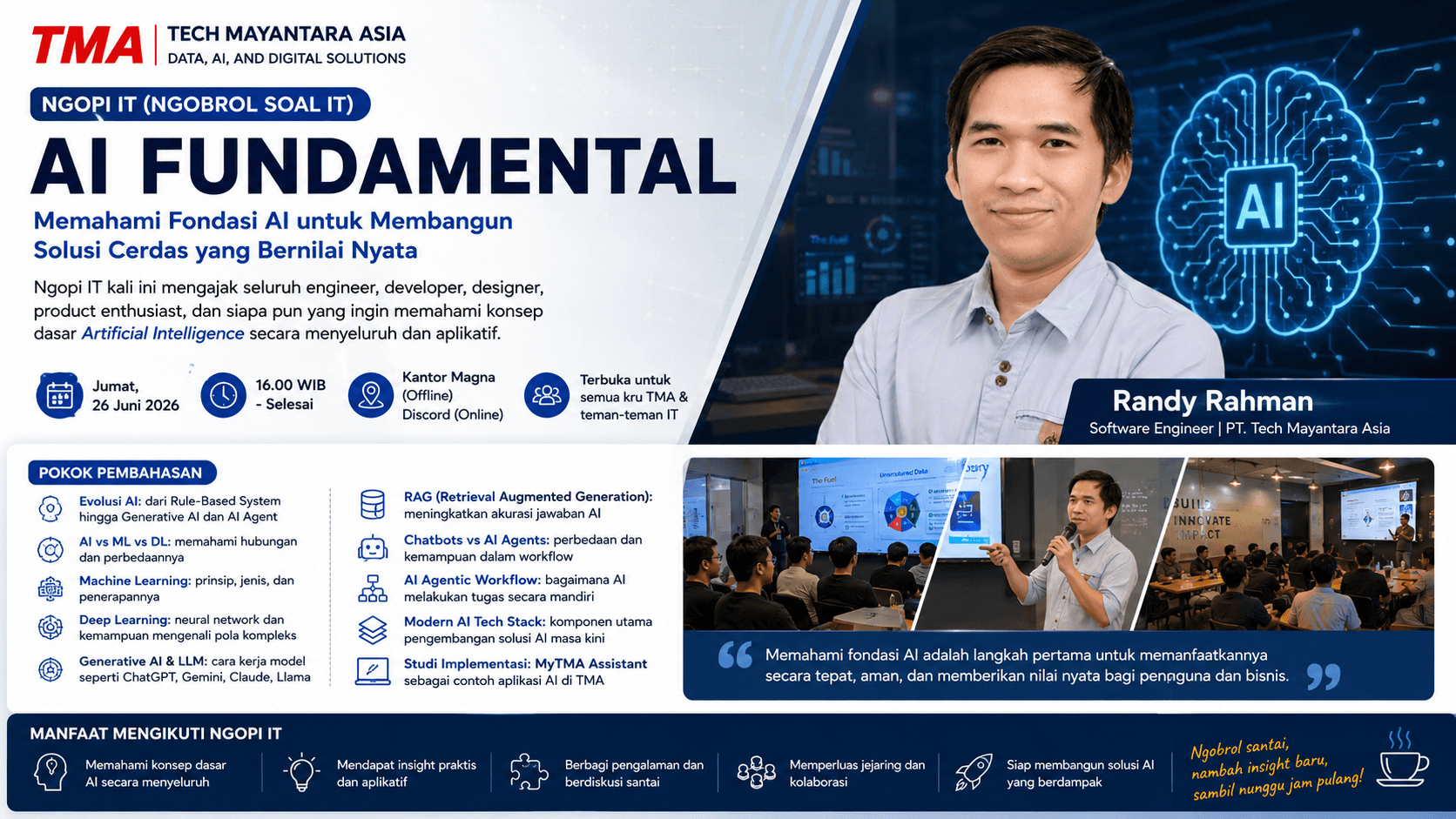
Bandung, June 26, 2026 – The rapid advancement of Artificial Intelligence (AI) has transformed the way organizations work, innovate, and make decisions. However, despite AI becoming increasingly accessible, many technology professionals still ask fundamental questions such as, "What exactly is AI?", "How does AI work?", and "Is now the right time to start learning AI?" Addressing these questions, PT Tech Mayantara Asia (TMA) once again hosted its regular Ngopi IT (Ngobrol Soal IT) knowledge-sharing session with the theme "AI Fundamental." The session was designed to provide participants with a solid understanding of Artificial Intelligence before diving into more advanced AI technologies. The presentation was delivered by Randy Rahman, Software Engineer at PT Tech Mayantara Asia.
Held both offline at the Magna Office in Bandung and online via Discord, the event took place on Friday, June 26, 2026, at 4:00 PM WIB. The session attracted software engineers, developers, UI/UX designers, product enthusiasts, and university students interested in expanding their understanding of AI. Staying true to the spirit of Ngopi IT, the event combined a relaxed atmosphere with in-depth technical discussions, creating an open environment where participants could freely exchange ideas and ask questions.
In his opening remarks, Randy Rahman emphasized that Artificial Intelligence is no longer just a technology trend—it has become a fundamental skill for professionals in the digital era. He pointed out that many people immediately begin using generative AI platforms such as ChatGPT or Gemini without first understanding the underlying concepts behind these technologies. According to Randy, having a solid foundation in AI enables individuals to leverage the technology more effectively, responsibly, and securely. This philosophy became the central objective of the AI Fundamentals session: to build the right mindset before exploring more sophisticated AI implementations.
The presentation began by introducing the definition of Artificial Intelligence and explaining why AI has become one of the most transformative technologies in the history of computing. Randy described AI as a branch of computer science focused on enabling machines to perform tasks that traditionally require human intelligence, such as recognizing patterns, understanding language, making decisions, and solving problems. Contrary to popular belief, AI is not limited to humanoid robots. Instead, most AI applications today exist as software operating behind the scenes in the digital services people use every day.
Participants were then guided through the historical evolution of AI over the past seven decades. Randy explained the progression from the Rule-Based Systems of the 1950s, which relied on manually written logical rules, to the emergence of Machine Learning in the 1990s, where computers began learning directly from data. The discussion continued with the rise of Deep Learning around 2012, enabling neural networks to recognize increasingly complex patterns, followed by the breakthrough of Generative AI, powered by transformer architectures and Large Language Models (LLMs). Finally, he introduced the latest evolution in AI technology: AI Agents, autonomous systems capable of performing multi-step tasks with minimal human intervention. This historical timeline helped participants appreciate that today's AI revolution is the result of decades of continuous research and innovation rather than an overnight technological breakthrough.
One of the most engaging segments of the session focused on the relationship between Artificial Intelligence, Machine Learning, and Deep Learning. Randy used a simple analogy to explain that Artificial Intelligence is the broad umbrella, Machine Learning is a subset of AI, and Deep Learning is a specialized branch within Machine Learning. This clear explanation helped participants understand that while all Deep Learning models belong to Machine Learning, and all Machine Learning techniques fall under AI, not every AI system relies on Machine Learning, nor does every Machine Learning approach require Deep Learning. By presenting these concepts visually and intuitively, Randy made complex technical ideas much easier to grasp.
The discussion then shifted toward Machine Learning, highlighting its ability to enable computers to learn from data without explicit programming for every possible scenario. Through examples involving training datasets and testing datasets, Randy demonstrated how AI models identify patterns from historical data before making predictions on unseen information. He introduced the three primary Machine Learning paradigms—Supervised Learning, Unsupervised Learning, and Reinforcement Learning—while illustrating their practical applications in industries such as sales forecasting, customer segmentation, recommendation systems, and autonomous vehicles.
Another key topic emphasized the importance of data as the "fuel" of Artificial Intelligence. Randy explained that the performance of any AI model is heavily dependent on the quality of the data used for training. He distinguished between structured data, such as information stored in relational databases, and unstructured data, including documents, emails, images, videos, and chat conversations. According to him, the remarkable progress of Generative AI in recent years has largely been driven by Deep Learning's ability to understand and process vast amounts of unstructured data, which significantly outweigh structured datasets in volume. This discussion broadened participants' perspectives, demonstrating that successful AI implementation depends not only on sophisticated algorithms but also on effective data management practices.
Moving into the subject of Deep Learning, Randy introduced the concept of Neural Networks, computational models inspired by the human brain. Through multiple hidden layers, neural networks are capable of identifying highly complex relationships within data that traditional Machine Learning methods often struggle to capture. This technology serves as the foundation for many modern AI applications, including facial recognition, Natural Language Processing (NLP), image recognition, voice assistants, and advanced recommendation systems used by digital platforms worldwide.
Perhaps the most anticipated segment of the event was Randy's discussion of Generative AI and Large Language Models (LLMs). He explained how models such as ChatGPT, Gemini, Claude, and Llama utilize transformer architectures to understand conversational context and generate human-like responses. However, Randy also reminded participants that these models are not infallible and may produce inaccurate or fabricated information. To address this challenge, he introduced the concept of Retrieval-Augmented Generation (RAG), a technique that connects language models with trusted organizational knowledge sources, enabling AI systems to deliver responses that are more accurate, context-aware, and aligned with business requirements.
The session concluded with an exploration of AI Agents, one of the latest trends in AI development. Randy highlighted the fundamental difference between traditional chatbots and AI Agents. While conventional chatbots primarily respond to user queries, AI Agents can autonomously perform sequences of tasks, including retrieving information from multiple systems, conducting analyses, executing workflows, and making decisions based on predefined objectives. He predicted that AI Agents would become one of the most significant technological developments in the coming years due to their potential to dramatically improve productivity and automate complex business processes.
To provide participants with a practical perspective, Randy presented the architecture of a Modern AI Tech Stack, covering components such as application layers, Large Language Models, embedding models, vector databases, and supporting infrastructure that together form enterprise AI solutions. He also showcased MyTMA Assistant, an internal AI platform developed to demonstrate how these technologies can be integrated into real-world business applications. This example helped participants bridge the gap between theoretical concepts and practical implementation in professional environments.
Throughout the session, participants actively engaged in discussions covering not only technical aspects of AI but also broader topics such as enterprise AI adoption, data security, AI ethics, career opportunities, and strategies for learning AI effectively. Questions regarding model selection, practical implementation, and the integration of AI into software development reflected the growing enthusiasm for Artificial Intelligence as a key driver of digital transformation.
By organizing the Ngopi IT: AI Fundamental session, PT Tech Mayantara Asia reaffirmed its commitment to fostering a culture of continuous learning and innovation. As technology evolves at an unprecedented pace, the ability to continuously acquire new knowledge has become an essential competency for every digital professional. Through a strong understanding of AI fundamentals, engineers are better equipped not only to utilize emerging technologies but also to design innovative, responsible, and impactful solutions for businesses and society.
More than just a technical seminar, Ngopi IT has become a collaborative learning platform where professionals from various disciplines come together to exchange knowledge, share experiences, and grow collectively. Through initiatives like this, TMA continues to nurture an ecosystem that empowers digital talent to remain adaptive, innovative, and well-prepared for the rapidly evolving era of Artificial Intelligence.