TeMA Security
TMA Strengthens Continuous CVE Monitoring Through TeMA Security Across Multiple Technology Stacks
PT Tech Mayantara Asia (TMA) is strengthening security monitoring across its technologies and applications through TeMA Security, continuously tracking developments in Common Vulnerabilities and Exposures (CVE). Amid the growing number of vulnerabilities discovered across various technology stacks, including during the Black October period, this approach helps identify potential risks, map affected components, and prioritize mitigation efforts. This initiative reflects TMA's commitment to building a more secure, proactive, and sustainable technology ecosystem.
20 November 2026
Notes from the work
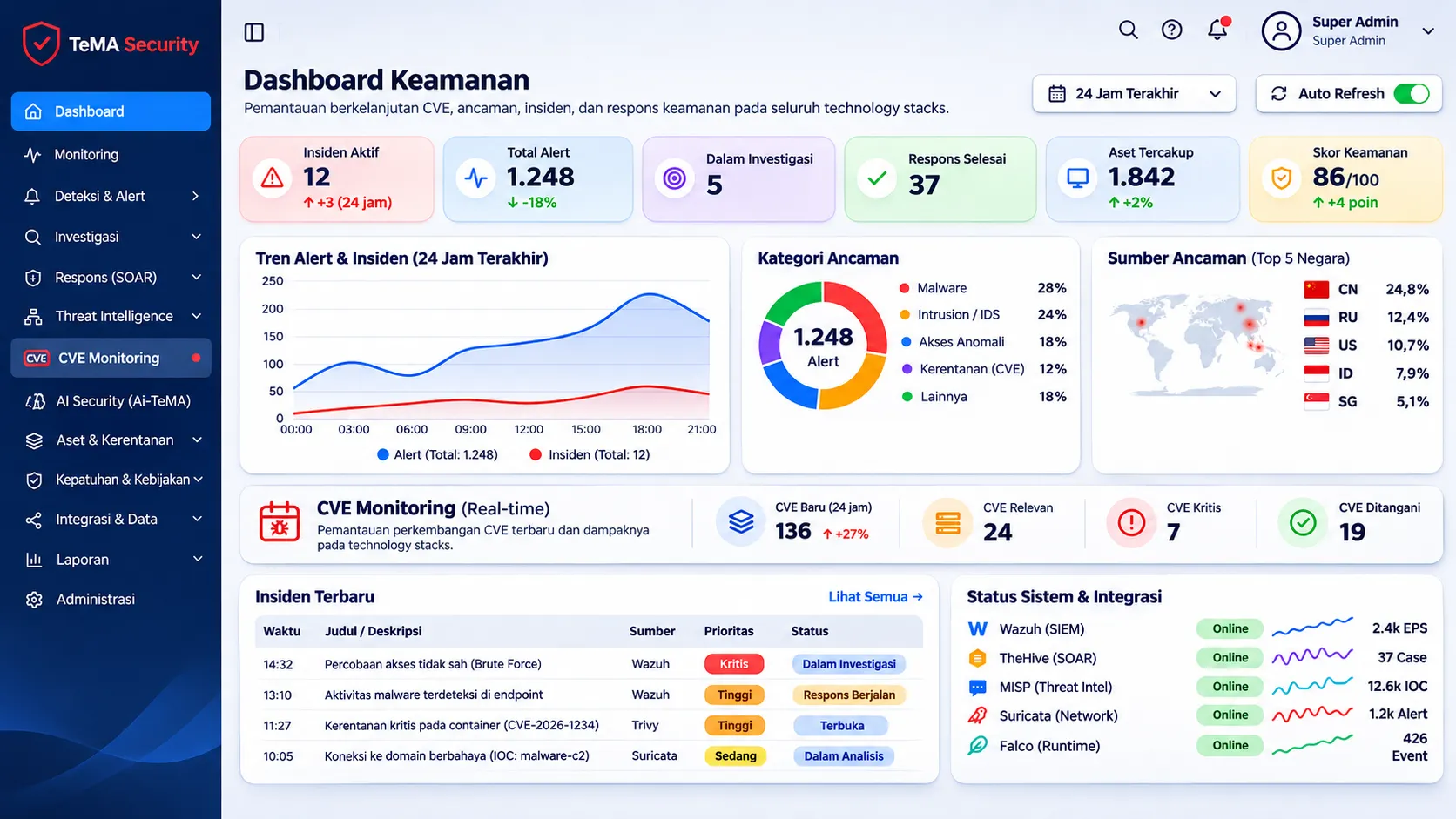
Bandung, November 2026 — The rapid evolution of information technology brings new challenges in maintaining the security of systems and applications. Every day, new security vulnerabilities are discovered across a wide range of technologies, including operating systems, programming frameworks, libraries, databases, web servers, and application infrastructure components. In response to these challenges, PT Tech Mayantara Asia (TMA) is strengthening its continuous security monitoring approach through TeMA Security, as part of its efforts to protect its technology ecosystem and the applications it manages.
One of the key focuses of this approach is monitoring developments in Common Vulnerabilities and Exposures (CVE). CVE is a vulnerability identification system that assigns a unique reference number to publicly identified security vulnerabilities. CVE information serves as an important source for technology and security teams to identify potential threats affecting software and technology components.
For companies managing multiple applications built on different technology stacks, vulnerability monitoring can no longer be treated as an occasional activity. Organizations need continuous monitoring mechanisms to identify, assess, and respond to emerging vulnerabilities in a timely manner.
Why Is CVE Monitoring Important?
In modern application development, systems are rarely built using a single technology. An application may combine programming languages, frameworks, third-party libraries, databases, containers, operating systems, and various supporting components.
Each of these components has its own development lifecycle and security update schedule. A vulnerability discovered in a single library or framework, for example, may affect multiple applications that depend on it. Even components that are not directly developed by internal teams can become potential sources of security risks.
This challenge has become increasingly relevant amid waves of newly discovered vulnerabilities across different technologies, including during the period referred to as Black October. Security incidents and vulnerability developments during this period serve as a reminder that threats can emerge simultaneously across multiple layers of technology.
The challenge for organizations is not simply knowing that a CVE has been published. They must also determine whether the vulnerability affects the technologies they use, assess its potential severity, and identify the appropriate actions required to address it.
Without structured monitoring, vulnerability information may be discovered too late. As a result, organizations may lose valuable time to mitigate risks before security weaknesses are exploited by malicious actors.
TeMA Security: Continuous Security Monitoring
Through TeMA Security, TMA is strengthening its security approach by adopting continuous security monitoring.
This approach makes vulnerability intelligence part of everyday security management activities. CVE developments need to be monitored continuously and correlated with the technologies and components used across application and infrastructure environments.
This means technology teams do not have to wait for a security incident to occur or conduct assessments only when a specific need arises. Instead, proactive monitoring helps identify potential risks as vulnerability information becomes available.
One important aspect of this process is technology stack mapping. Organizations need to maintain visibility into the programming languages, frameworks, libraries, database versions, operating systems, and other components used by each application. This information provides the foundation for determining whether a newly published CVE is relevant to the managed technology environment.
For example, when a new vulnerability is reported in a particular framework or library, the information can be compared against the inventory of components and versions used across applications. If a match is identified, the affected systems can be examined further to determine their exposure and the appropriate mitigation measures.
From Vulnerability Intelligence to Mitigation Actions
CVE monitoring delivers its greatest value when followed by proper analysis and remediation. Not all vulnerabilities have the same level of severity or impact. Therefore, CVE information needs to be evaluated based on severity, vulnerability characteristics, exploitability, and its relevance to the systems and components in use.
A structured security management approach may include the following activities:
- CVE Monitoring: Tracking security vulnerability publications from relevant information sources.
- Technology Stack Mapping: Identifying the technologies, frameworks, libraries, and versions used across applications.
- Vulnerability Assessment: Analyzing whether newly discovered vulnerabilities affect the components in use.
- Risk Prioritization: Determining remediation priorities based on risk severity and potential impact.
- Remediation Planning: Preparing mitigation measures, such as version upgrades, security patches, configuration changes, or other protective actions.
- Continuous Monitoring: Tracking new vulnerability developments and ensuring that security responses remain relevant.
This process helps transform widely distributed vulnerability information into a more structured foundation for technical decision-making.
Supporting Security Across Multiple Technology Stacks
Enterprise technology environments are generally diverse. Within a single organization, applications may be built using PHP, Python, JavaScript, Java, and other programming languages. Each technology has its own ecosystem of frameworks, dependencies, and security update mechanisms.
This diversity makes a centralized monitoring approach increasingly important. Security and application management teams need a comprehensive view of vulnerabilities across their systems, rather than relying solely on isolated security checks for individual applications.
Through TeMA Security, TMA positions vulnerability monitoring as an integral part of application and infrastructure security management. The objective is to help organizations gain better visibility into potential risks, accelerate the identification of affected components, and improve coordination among development, infrastructure, and operations teams.
Building a Proactive Security Culture
TMA believes that cybersecurity is not a task that ends when an application is launched or infrastructure is deployed. Security is an ongoing process that must evolve alongside technological developments and emerging threats.
The discovery of new CVEs, together with the changing vulnerability landscape during periods such as Black October, reinforces the importance of organizational awareness and preparedness in addressing cybersecurity challenges.
Through TeMA Security, TMA continues to promote a more proactive, measurable, and continuous approach to security. CVE monitoring serves as one of the foundations for helping organizations understand the risks associated with their technology environments and take appropriate action before potential vulnerabilities develop into security incidents.
Ultimately, building secure systems is not simply about adopting the latest technologies. It also requires ensuring that every component within those systems is continuously monitored, evaluated, and maintained.
Guided by its philosophy of Technology with True Humanity, TMA is committed to delivering technology solutions that are not only functional and innovative but also prioritize security, reliability, and long-term sustainability for their users.