TMA Development Methodology: An Agile-Hybrid Approach for Modern Digital Solutions
In the face of increasingly complex digital transformation demands, organizations require a development methodology that is not only fast but also adaptable to change while still complying with strict governance standards. PT Tech Mayantara Asia (TMA) addresses this need through a development approach that combines speed, flexibility, and control by adopting Agile principles, incremental delivery, and a hybrid model tailored for enterprise environments.
At its core, TMA’s development methodology is based on Agile principles, an approach to system development that is iterative and incremental. In practice, the development process is divided into short cycles known as sprints. Each sprint is designed to produce deliverables that provide tangible business value, enabling users to benefit from the system without having to wait for the entire project to be completed. This approach allows for rapid user feedback, which is then used to continuously improve the product in subsequent iterations.
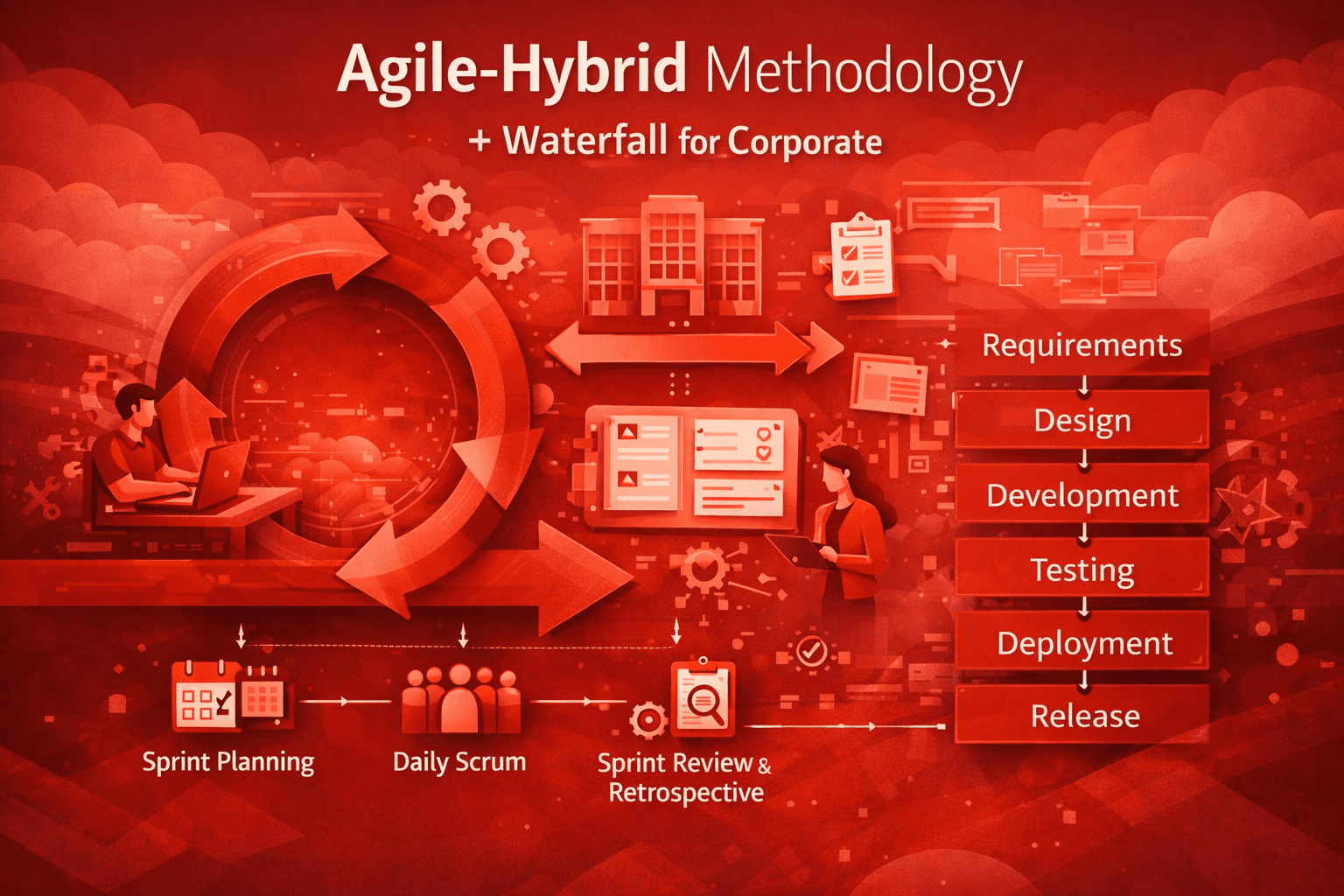
However, TMA does not rely solely on pure Agile practices. To address the needs of enterprise-level projects that involve high complexity, multiple stakeholders, and strict regulatory requirements such as audits, IFRS, data protection laws, and ISO standards, TMA implements an Agile-hybrid approach. This method combines the flexibility of Agile with the structure and discipline of traditional methodologies such as Waterfall. As a result, initial planning is clearly defined, including scope, milestones, and deliverables, while formal documentation such as Business Requirement Specifications (BRS) and Technical Requirement Specifications (TRS) is thoroughly prepared.
Within this Agile-hybrid implementation, development continues to be carried out in iterative sprints, while control and approval processes follow established governance standards, including those required by large enterprise partners such as PT Telkom. This approach strikes a balance between flexibility and regulatory compliance, making it highly suitable for large-scale projects that demand strong accountability.
Operationally, TMA also enforces disciplined project management practices by utilizing open-source tools to manage backlogs, sprint planning, daily scrums, and sprint evaluations. The sprint cycle is structured and consistent, beginning with planning at the start of the week, followed by daily scrums for team coordination, and concluding with evaluation and retrospective sessions to improve performance in the next cycle. This ensures that every team member has clear visibility into progress and potential challenges throughout the development process.
Beyond methodology, TMA integrates DevOps practices into the entire development lifecycle. One of the key implementations is the use of Continuous Integration and Continuous Delivery (CI/CD), which automates code integration and deployment processes. With CI/CD, the time between development and production is significantly reduced, allowing products to be tested and validated quickly while receiving immediate user feedback. This also ensures consistent delivery of value in every sprint.
To support this, TMA utilizes centralized version control and repository management systems, ensuring that every code change is well-documented and traceable. Activity logging and version management play a crucial role in maintaining system quality and stability, especially when changes occur across multiple layers of the solution. This approach enables easier tracking of changes and minimizes risks, while simplifying debugging processes.
In addition to development and deployment, TMA places strong emphasis on documentation as an integral part of its methodology. All personnel, from management to developers, are encouraged to consistently document processes and outputs. The guiding principle is “do what is written and write what is done,” reflecting a strong commitment to transparency and accountability. This documentation not only supports internal needs but also plays a vital role in meeting audit and governance requirements.
From a technology perspective, TMA’s development methodology is supported by modern approaches, including DevOps, containerization, cloud-native architecture, API-first design, and microservices. These approaches enable systems to be highly flexible, easily integrated, and independently scalable and maintainable. Automated testing ensures application quality, while the concept of security by design ensures that security considerations are embedded from the early stages of development.
A key component of TMA’s development ecosystem is the use of the TeMA platform as a Rapid Platform Development (RPD) solution. This platform is designed to accelerate application development by providing ready-to-use core functionalities such as user management, role management, role-based access control (RBAC), and UI templates. With these foundational components in place, developers can focus on building core business features rather than starting from scratch.
The TeMA platform architecture is also built on modern principles, with a clear separation between frontend and backend. The backend is developed using a microservices approach, allowing each service to operate independently. This design provides high flexibility in deployment, whether on bare metal infrastructure, virtual machines, container-based environments, or cloud-native platforms. Additionally, its modular and loosely coupled architecture makes it easy to add or remove features based on evolving business needs.
In terms of security and data governance, the TeMA platform is designed in compliance with data protection regulations. It supports authentication and authorization mechanisms, including multi-factor authentication (MFA) and strict role-based access control. Furthermore, all user activities are recorded through logging and audit trails, enabling comprehensive tracking and monitoring. This is essential for ensuring transparency and system security, particularly in enterprise-scale applications.
Scalability and reliability are also key strengths of TMA’s approach. With a microservices architecture and containerization support, systems can easily scale up or down based on demand. This ensures optimal performance even during periods of increased workload.
Overall, TMA’s development methodology represents a powerful combination of Agile practices, governance discipline, and modern technology utilization. By integrating methodology, project management, and technological solutions into a unified framework, TMA is able to deliver digital solutions that are not only rapidly developed but also high-quality, secure, and scalable. This approach positions TMA as a reliable partner capable of addressing digital transformation challenges across various industries in an effective and sustainable manner.