Decision Engine: Bridging the Gap Between Insight and Action in Enterprise AI
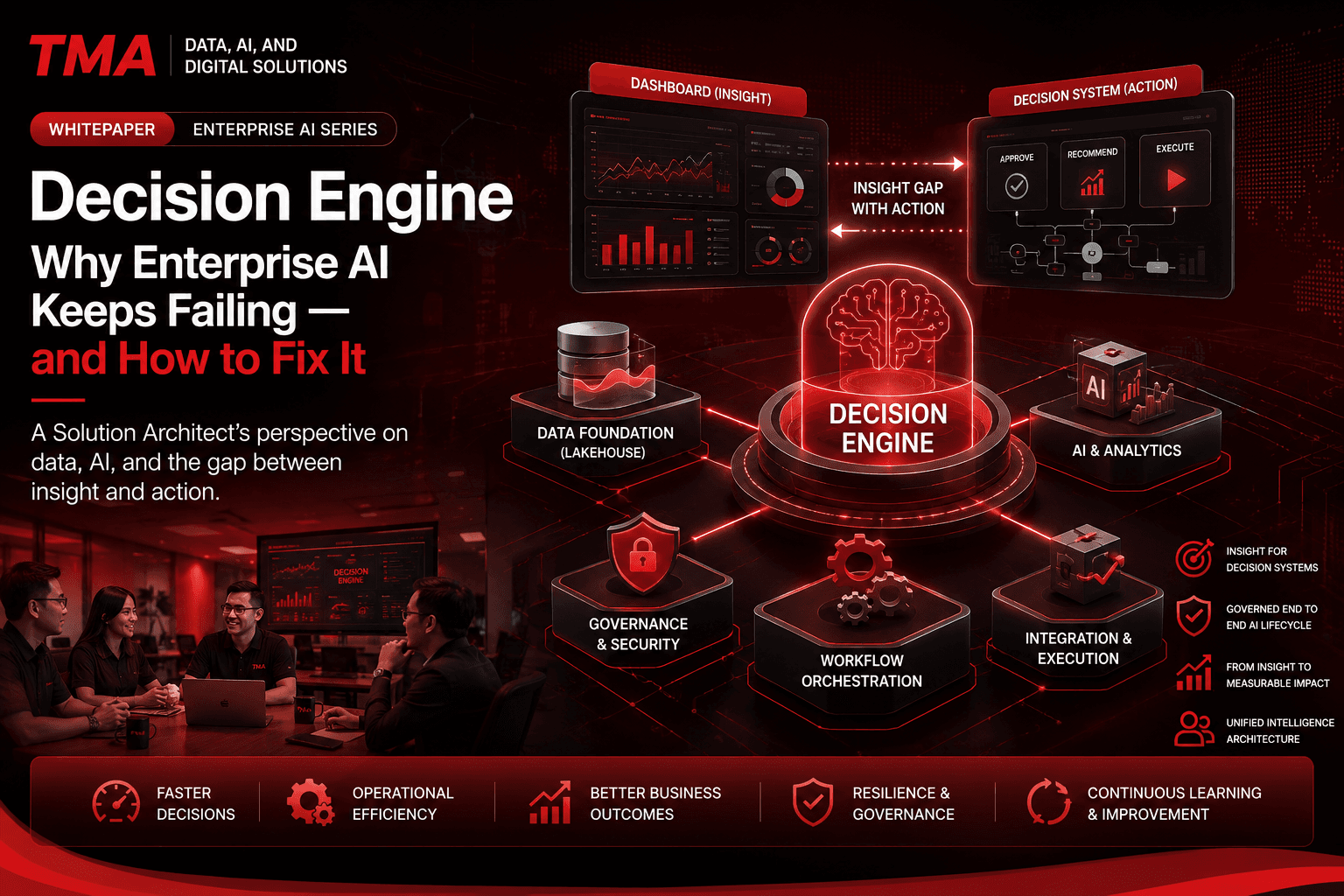
Amid the rapid advancement of artificial intelligence (AI) technologies, many organizations are racing to adopt AI in order to improve efficiency, productivity, and decision-making quality. However, in reality, many AI initiatives still fail to deliver meaningful business impact. This issue becomes the central focus of the whitepaper “Decision Engine: Why Enterprise AI Keeps Failing — and How to Fix It”, which explores how modern organizations must move beyond simply generating insights toward building decision-making systems that can truly execute operational actions.
The whitepaper explains that most AI implementation failures are not caused by a lack of data or weak AI technologies. On the contrary, organizations today possess enormous amounts of data and increasingly sophisticated AI capabilities. The primary challenge lies in fragmented architectures, disconnected workflows, weak governance, and the inability to transform intelligence into real executable decisions.
This phenomenon is referred to as the “Intelligence Gap,” the distance between insights generated by dashboards or analytics systems and the actual actions executed within organizations. Many enterprises have impressive dashboards and comprehensive reports, yet the insights often stop at the observation level and never become operational decisions.
The whitepaper proposes a new approach through the concept of a Decision Engine, an integrated architectural system that connects data, analytics, AI, workflows, governance, and business processes into a unified ecosystem. Its primary goal is not merely to produce insights, but to ensure those insights are translated into measurable and sustainable business actions.
In traditional environments, data is often scattered across departmental silos. AI pipelines operate independently without direct integration with business workflows. Governance exists merely as an administrative compliance layer rather than being embedded into the system itself. As a result, organizations struggle to create responsive and real-time decision-making systems.
Through the concept of a Unified AI Data Platform, the whitepaper emphasizes the importance of building an integrated environment that connects data, analytics, AI, and operational workflows within a comprehensive architecture. Governance is no longer treated as a compliance burden, but instead embedded directly into ingestion, processing, modeling, deployment, and AI lifecycle monitoring processes.
One of the key messages highlighted is that data should not stop at reports or dashboards alone. Financial insights, market insights, and operational insights must become the foundation of enterprise decision-making. When analytics, governance, deployment, and AI are integrated into a single platform, organizations can move from merely “seeing” toward making real-time decisions.
The core concept behind the Decision Engine is bridging the gap between insight and action. The whitepaper explains that AI must be embedded directly into operational workflows, including approval systems, recommendation engines, and execution processes. With this approach, insights are no longer passive outputs but active components of daily business operations.
In addition, the Decision Engine introduces the concept of closed-loop decision governance, where the system continuously monitors outcomes, feedback, and KPI impacts from every decision taken. This enables organizations to build continuous learning mechanisms, allowing systems to become increasingly intelligent over time.
From an architectural perspective, the whitepaper describes several key components that form a modern Decision Engine system. The first is the Data Foundation (Lakehouse), which eliminates silos and creates a single trusted data source. The second is the Data-to-AI Lifecycle, an integrated pipeline connecting ingestion, engineering, training, and AI deployment continuously. The third is Governance as a Core Layer, ensuring security, traceability, accountability, and strategic alignment are embedded directly into the system.
Other critical components include the Compute & AI Layer, supporting enterprise-scale AI processing, and Workflow Orchestration, which transforms predictions and intelligence into automated real-time business actions. The whitepaper also stresses the importance of aligning data, insights, planning, execution, and measurement so that the entire decision-making process remains consistent with organizational business objectives.
As an implementation example, the whitepaper presents a Policy Intelligence System use case—an AI-driven forecasting system integrating social, economic, and workforce data to help organizations or governments make evidence-based decisions. This system can improve forecasting accuracy, accelerate decision-making, optimize resource allocation, and enhance overall operational efficiency.
The whitepaper also highlights the importance of supporting tools such as business dashboards, scenario modeling, cross-functional meetings, and real-time reporting to strengthen coordination and execution within organizations. Technology alone is not enough; organizations also need a collaborative culture that encourages transparency, open dialogue, and shared business awareness across teams.
The success of Decision Engine implementation is measured not only by technological sophistication, but also by improvements in decision-making speed, operational efficiency, revenue consistency, business agility, and the organization’s ability to adapt to change.
Looking ahead, organizations are expected to become increasingly dependent on predictive insights, AI-driven analytics, and automated real-time decision-making. Modern enterprise systems will no longer simply display data; they will also be capable of responding automatically based on continuously evolving intelligence.
Ultimately, the whitepaper delivers one critical message: the greatest value of AI does not lie in how sophisticated the models are, but in an organization’s ability to transform insights into actions that generate real business impact. In the modern enterprise world, data without execution is merely observation. However, when data, AI, governance, and workflows are integrated into a mature Decision Engine, organizations can move toward faster, smarter, and more strategic decision-making.
This is the whitepaper file that can be downloaded.
https://techmayantara.co.id/api/file/file/Decision-engine_WP.pdf