Company
TMA and Telkom University Strengthen Academic and Industry Collaboration Through AI Social Media & News Analytics Project
In a digital transformation that keeps speeding up, collaboration between industry and academia is one of the key factors in building digital talent ready for real challenges in the field. As a technology company focused on data solutions, artificial intelligence, and digital platforms, PT Tech Mayantara Asia (TMA) keeps its commitment to build close ties with universities, including Telkom University (Tel-U).
15 June 2026
Notes from the work
In a digital transformation that keeps speeding up, collaboration between industry and academia is one of the key factors in building digital talent ready for real challenges in the field. As a technology company focused on data solutions, artificial intelligence, and digital platforms, PT Tech Mayantara Asia (TMA) keeps its commitment to build close ties with universities, including Telkom University (Tel-U).
The partnership between TMA and Telkom University goes beyond internship programs or field work practice. It also covers project mentoring, student competence development, training in current technology, and exposure to real industry challenges. Through this approach, students gain academic experience and a chance to build solutions that fit what the world of work needs.
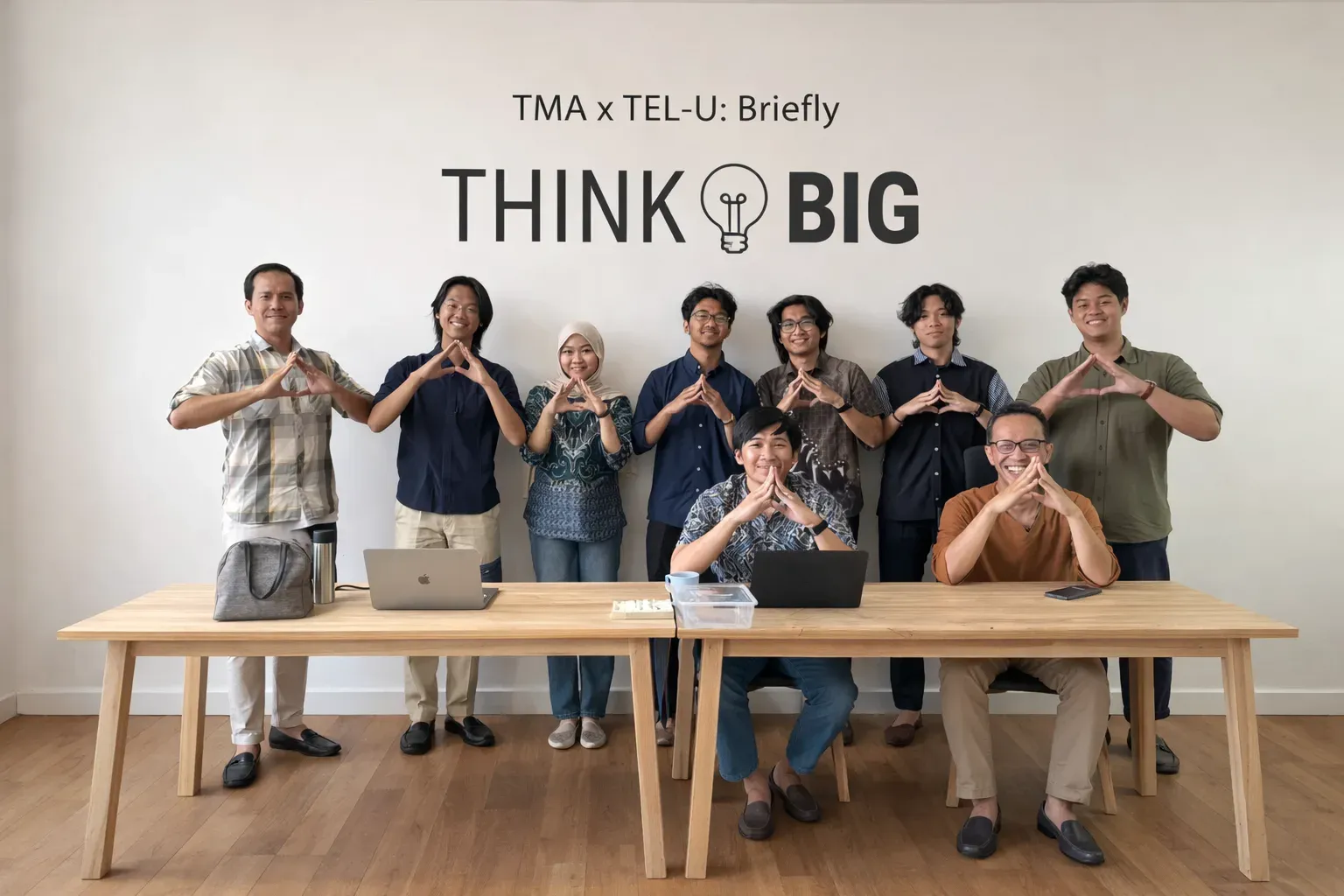
One concrete form of the collaboration was a mentoring program for final-year students of the Informatics Study Program, Faculty of Informatics, Telkom University, who developed an Artificial Intelligence (AI) solution for news and digital media analysis. The student team was led by I Made Dwi Wiryawan Raditya as Project Manager, with team members covering AI Engineer, Front-end Developer, Back-end Developer, and Quality Assurance Engineer roles (M. Reyenno Rakhazhillan S., Farhan Ahmad Naufal, Galuh Ambar Setiana, Fransiskus Harris B. and Timothy Hinsan Widjaja, Rizky Abadi).
The programme culminated on 12 June 2026, when the team gave its final project presentation before supervising lecturers, industry mentors, and others involved in the academic partnership.
The project took a theme that fits today's information age: how to help users deal with information overload caused by the huge volume of digital news published every day. The team found that business analysts, journalists, researchers, and decision makers often struggle to track public sentiment, news trends, and sector impact quickly and objectively, because they have to read news from many sources by hand.
As a solution, the team built a platform called Briefly – News Summarize AI Agent. It is an AI-based system that runs the whole chain end to end: gathering news, grouping topics, automatic summarisation, sentiment analysis, and prediction of sector impact.
The project did not stay on the academic side. It was designed with an engineering approach close to modern industry practice. Briefly runs on an asynchronous pipeline architecture with four main workers: news scraping, smart clustering, summarise and sentiment analysis, and sector impact prediction. The results then appear in an interactive web dashboard.
In the first stage, the system automatically collects news from Indonesian news portals through Google News RSS and extracts content using open source technology. It then groups the news with embedding and clustering techniques so that items on similar topics land in the same group. Next, the AI summarises the news and analyses sentiment toward the actors or parties named in it. The last stage predicts which industry sectors may be affected by the reported events.
All processing results appear in a dashboard where users can search, filter by category, and see news summaries, sentiment, and earlier insights in real time.
From an industry view, TMA sees the project as a strong example of students applying Data Engineering, Artificial Intelligence, Natural Language Processing (NLP), Machine Learning, and Software Engineering concepts in a solution with real implementation potential.
One aspect that drew special attention from the TMA mentors was how the team kept the solution efficient while running on free-tier infrastructure. They used modern technology such as Python AsyncIO, Sentence Transformers, Groq LLM, PostgreSQL, Next.js, and Supabase to build a system that runs at an operating cost close to zero dollars a month.
The approach shows that innovation does not always need expensive infrastructure. With a good grasp of architecture and the right technology choices, students can build solutions that are scalable, modern, and relevant to industry needs.
For TMA, programs like this carry real strategic value. They let us share practical experience with students and open wider room for collaboration between campus and industry. Students get a chance to understand the real challenges of building a digital product, while the company gains a new perspective and fresh ideas from the next generation of technology talent.
The collaboration is also part of TMA's commitment to support the growth of the national technology ecosystem. Industry needs people who are strong in theory and also have experience building real solutions. Internships, field work practice, project mentoring, and research collaboration are therefore important instruments to bridge that need.
During the mentoring, students learned the technical side of building an AI application. They also learned how a product is designed from the user's view, how to validate a solution, how to shape an efficient architecture, and how to weigh operations and long-term product sustainability.
The final presentation on 12 June 2026 was an important moment that showed the team's hard work through the learning and development process. Besides presenting the implementation, the team set out its development roadmap: better analysis accuracy, user personalisation, a public API, and a wider range of news sources.
TMA gives high appreciation to every member of the team led by I Made Dwi Wiryawan Raditya, and to supervising lecturer Agus Fachrur Rozy, S.Si., M.Stat., who supported and guided the project to its final stage.
Going forward, TMA hopes the synergy with Telkom University can keep growing through other collaboration programs. By combining academic strength and industry experience, both sides can produce innovation that brings real benefit to the community, businesses, and the growth of technology in Indonesia.
Through collaboration like this, TMA believes the future of Indonesian technology can be built by young talent who master theory and can also create real solutions to today's challenges. This mentoring program shows that when campus and industry move together, the innovation that emerges is more than an academic assignment. It can grow into a product with real impact.