TeMA Platform with Rust
TeMA Platform Expands Backend Technology Support with Rust and Axum for High-Performance API Development
PT Tech Mayantara Asia (TMA) is expanding TeMA Platform capabilities by adding Rust and the Axum framework as backend technology options, complementing its existing support for PHP, Python, Node.js/Next.js, and Go. This addition addresses the growing demand for high-performance API and backend services that require low latency and efficient resource utilization, while providing developers with greater flexibility in building modern applications and digital services.
21 November 2026
Notes from the work
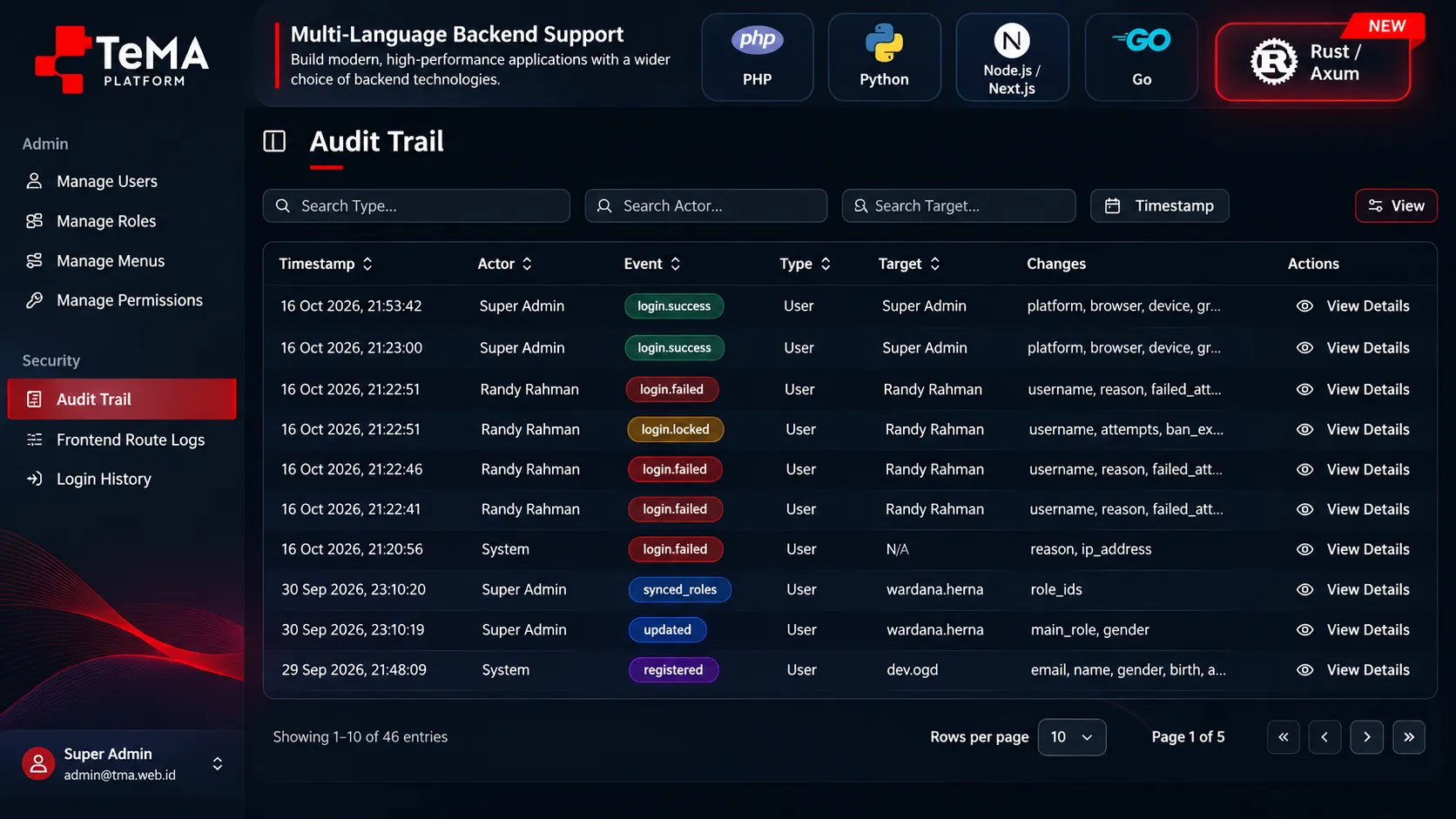
Bandung, November 2026 — PT Tech Mayantara Asia (TMA) continues to enhance the capabilities of TeMA Platform as a Rapid Development Platform designed to support modern application development needs. One of its latest enhancements is the addition of Rust with the Axum framework as a supported backend (BE) technology. This expands the existing range of technologies, which already includes PHP, Python, Node.js/Next.js, and Go.
The addition of Rust/Axum reflects TMA's response to growing technology demands, particularly for API (Application Programming Interface) development requiring high performance, low response times, efficient resource utilization, and the ability to handle large volumes of requests. As application requirements and system integration needs continue to grow, backend technology selection has become an important factor in determining application performance and scalability.
Addressing the Need for Lightweight and High-Speed APIs
In modern application architectures, APIs play a critical role in connecting frontend applications, backend services, internal systems, and external platforms. They support various functions, including data exchange, authentication, service integration, and communication between components within an application ecosystem.
As user numbers and data exchange volumes increase, APIs are expected to deliver fast responses without consuming excessive infrastructure resources. For high-traffic systems, efficient CPU and memory utilization are also important considerations.
Rust has emerged as an attractive technology for these requirements. It is a programming language designed with a strong focus on performance and memory safety. Rust provides efficient execution without requiring a garbage collector, allowing memory management to be handled through a more controlled approach.
These characteristics make Rust particularly relevant for building backend services that require low latency, fast processing, and efficient resource utilization. It can serve as an excellent option for APIs that act as critical communication channels between applications and digital services.
Axum as a Rust Backend Framework
To support Rust-based backend development, TMA has introduced Axum as one of the frameworks supported by TeMA Platform.
Axum is a web framework for Rust built on the asynchronous Rust ecosystem and powered by Tokio as its asynchronous runtime. It provides a structured approach to building HTTP services and REST APIs, including routing, request handling, middleware, and integration with other supporting components.
One of Axum's key advantages is its modular design and its use of Rust's type system. This helps developers build more organized backend services while benefiting from Rust's built-in memory safety and type-checking capabilities.
The combination of Rust and Axum provides a compelling alternative for developing high-performance APIs. It can also be used to build microservices, data integration services, service gateways, and backend components that handle computationally intensive workloads.
With this addition, developers have a wider range of technology options to match application requirements with the characteristics of the services being developed.
Expanding the TeMA Platform Technology Ecosystem
Before the introduction of Rust/Axum, TeMA Platform already supported several backend technologies:
- PHP – for developing web applications and business systems with diverse integration requirements.
- Python – for backend development, data services, automation, and integration with artificial intelligence and data processing ecosystems.
- Node.js/Next.js – for developing JavaScript-based applications and services integrated with modern frontend ecosystems.
- Go – for building efficient, concurrent backend services suitable for distributed systems.
- Rust/Axum – for backend and API development that prioritizes performance, resource efficiency, and memory safety.
The addition of Rust/Axum is not intended to replace the existing technologies. Instead, it enriches the available architectural choices and gives development teams greater flexibility in selecting the most appropriate technology for each project.
Each programming language has its own characteristics, ecosystem, and strengths. PHP is suitable for business applications, Python is strong in data processing and AI integration, Node.js supports the JavaScript ecosystem, Go offers efficiency for concurrent services, while Rust/Axum provides an alternative for services requiring high performance and resource efficiency.
Enabling More Flexible Application Architectures
With a broader range of backend technologies, TeMA Platform increasingly supports flexible application development approaches. A solution does not necessarily need to be built using a single programming language across all its components.
In modern architectures, applications can consist of multiple services built with different technologies and communicating through APIs. For example, a primary application may use PHP or Python, while a specific service requiring faster processing can be developed using Rust/Axum. Both can communicate through standardized API mechanisms.
This approach allows developers to select technologies based on the requirements and characteristics of individual components, rather than forcing a single technology to serve the entire system.
TeMA Platform is designed to support this development model by providing an increasingly diverse range of backend development capabilities. As a result, development teams can design applications that are modular, integrated, and adaptable to evolving business requirements.
Continuous Innovation Across the TeMA Ecosystem
The addition of Rust/Axum is part of TMA's commitment to continuously evolving TeMA Platform in response to technological developments and industry needs. For TMA, a development platform should offer more than just tools for building applications. It must also adapt to changing requirements in performance, scalability, security, and infrastructure efficiency.
With Rust/Axum now available, TeMA Platform offers an increasingly comprehensive selection of backend technologies, including PHP, Python, Node.js/Next.js, Go, and Rust.
This enhancement strengthens TeMA Platform's position as a development platform that provides technological flexibility for developers and organizations. Ultimately, technology selection is not about determining which programming language is universally superior, but about choosing the technology that best addresses a particular requirement.
Through a commitment to innovation and continuous learning, TMA will continue expanding TeMA Platform's capabilities to support the development of digital solutions that are faster, more efficient, reliable, and ready to meet future technological challenges.