Digital Engineering
NGOPI TMA discusses React Native and AI-assisted development, building a relaxed and productive learning culture
In his presentation, Varyl explained how mobile app development has changed greatly. Where the workflow used to run manually from design to debugging, developers can now use AI-assisted development to speed up the work. The material described the shift in the modern workflow from:
13 May 2026
Notes from the work
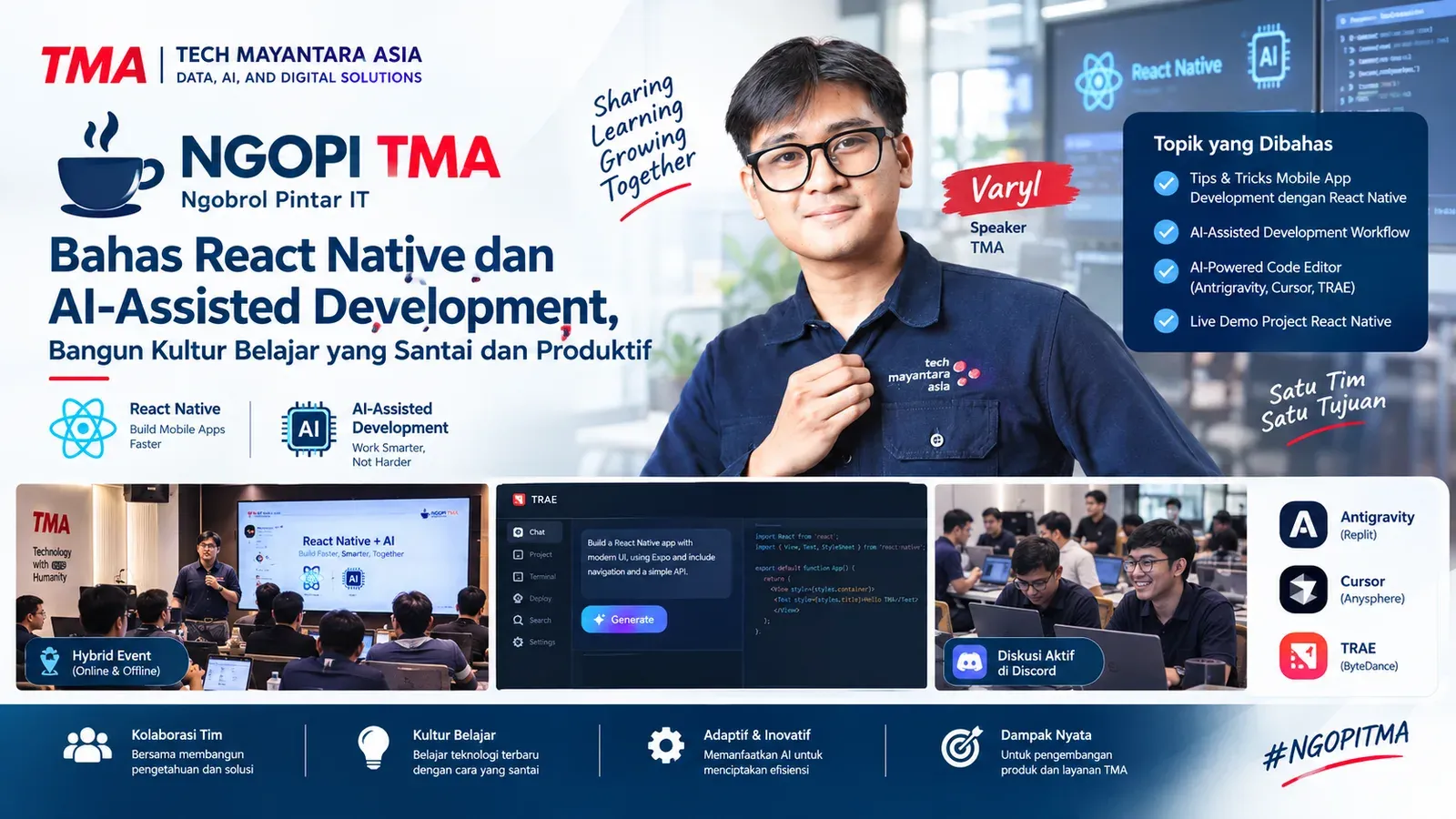
On 8 May 2026, TMA again held its internal event NGOPI (Ngobrol Pintar IT), a discussion and knowledge-sharing forum that is part of the company's learning culture. More than an ordinary technical sharing session, NGOPI has grown into an open communication space that brings together ideas, experience, and technology exploration in a relaxed but still high-quality setting.
This session ran in a hybrid format: online on Discord and offline at the TMA Bandung office. The hybrid approach let every team member, whether remote or onsite, join the discussion without location limits. The room felt lively from the start, with active interaction between online and offline participants.
The main theme this time was presented by Varyl and Ibnu, who raised Tips and tricks for mobile app development with React Native. The material covered not only conventional mobile app development but also how AI is starting to change the way developers build apps: faster, more flexible, and more efficient.
In his presentation, Varyl explained how mobile app development has changed greatly. Where the workflow used to run manually from design to debugging, developers can now use AI-assisted development to speed up the work. The material described the shift in the modern workflow from:
Figma → Manual Coding → Manual Debugging → Done
to:
Figma → Convert Screenshot to Code → AI reads the folder structure → AI-Assisted Testing
This drew participants' attention because it described AI becoming a working partner for developers, not just an extra tool. Many were enthusiastic as Varyl showed how AI can help read a project structure, generate code automatically, and help test applications more efficiently.
Beyond the modern workflow, the NGOPI session also covered the AI-powered code editors that are popular today for mobile and web app development. The workshop material discussed tools such as Antigravity (Replit), Cursor (Anysphere), and TRAE (ByteDance).
Ibnu explained that each platform has different characteristics. Cursor is known as very strong for web development and needs detailed prompts, while TRAE is seen as more flexible and able to understand simple prompts more naturally. Interestingly, TRAE was also rated a good fit for mobile app development with React Native because it can produce more dynamic designs and connect directly to Figma or an image reference.
The discussion grew livelier when it reached implementation of React Native with AI-assisted coding. Participants saw how the initial setup can run faster with English prompts so the AI produces better output.
The event did not stop at theory. It also included a live demo of a React Native project that made the session more interactive. The demo showed how an app can run in a web browser or the Android Studio emulator with a fairly simple process. Many participants tried the steps right away while discussing in the Discord channel set up for the workshop.
One of the parts that drew the most attention was when Varyl explained the “Give TRAE Freedom” idea: giving the AI room to improvise on design and development based on the prompt the developer provides. This opened a new perspective that AI is not only a coding aid but can also be a creative partner in app development.
Another equally interesting topic was how TRAE can help developers update the look of an app just by providing a reference image and a few extra prompts. This shows how AI technology is changing UI/UX development to be much faster and more adaptive.
In the middle of fairly technical material, the mood stayed relaxed and full of humor. Many light jokes came from participants and speakers, yet stayed relevant and high quality. It is moments like that which made the discussion fluid and never dull. The “serious but relaxed” culture TMA has built was clearly felt at this NGOPI.
Beyond being a place to learn technology, NGOPI also plays an important role in building a healthy communication culture at the company. With an open discussion format, every participant feels more comfortable sharing an opinion, asking, or telling their experience. There is no stiff formal wall between senior and junior engineers, so learning flows naturally and collaboratively.
The use of Discord as the main platform is also an important part of supporting modern work culture at TMA. Besides meetings and discussions, Discord has grown into a daily collaboration medium that complements other communication platforms such as Telegram and WhatsApp. With voice channels, screen sharing, and topic-based discussion, Discord lets technical communication run more flexibly and in real time.
This NGOPI also showed how TMA keeps pushing the internal team to adapt to the latest technology, especially in AI and software engineering. Combining React Native with AI-assisted development is seen as a highly relevant direction for the future of the mobile app industry.
At the end of the event, many participants said they were interested in exploring AI use in their daily development workflow. Quite a few also began to imagine how tools such as TRAE and other AI coding assistants could be integrated into TMA's internal product development going forward.
Through NGOPI, TMA again showed that learning technology does not always have to be formal and stiff. With a more open, relaxed, and collaborative approach, knowledge transfer becomes more effective and enjoyable.
NGOPI is not just a technical discussion forum. It has also become a symbol of a company culture that keeps growing with technology, communication, and an endless spirit of learning.