Company
NGOPI TMA: Building a product thinking mindset for engineers
Unlike earlier themes that focused mostly on technology and technical implementation, this NGOPI raised a topic highly relevant to product and business growth: “Product Thinking for Engineers.” Two internal TMA speakers, Randy Rahman and Salman Artadi, presented the material. They invited participants to see product development from a wider perspective than just writing code or building features.
8 June 2026
Notes from the work
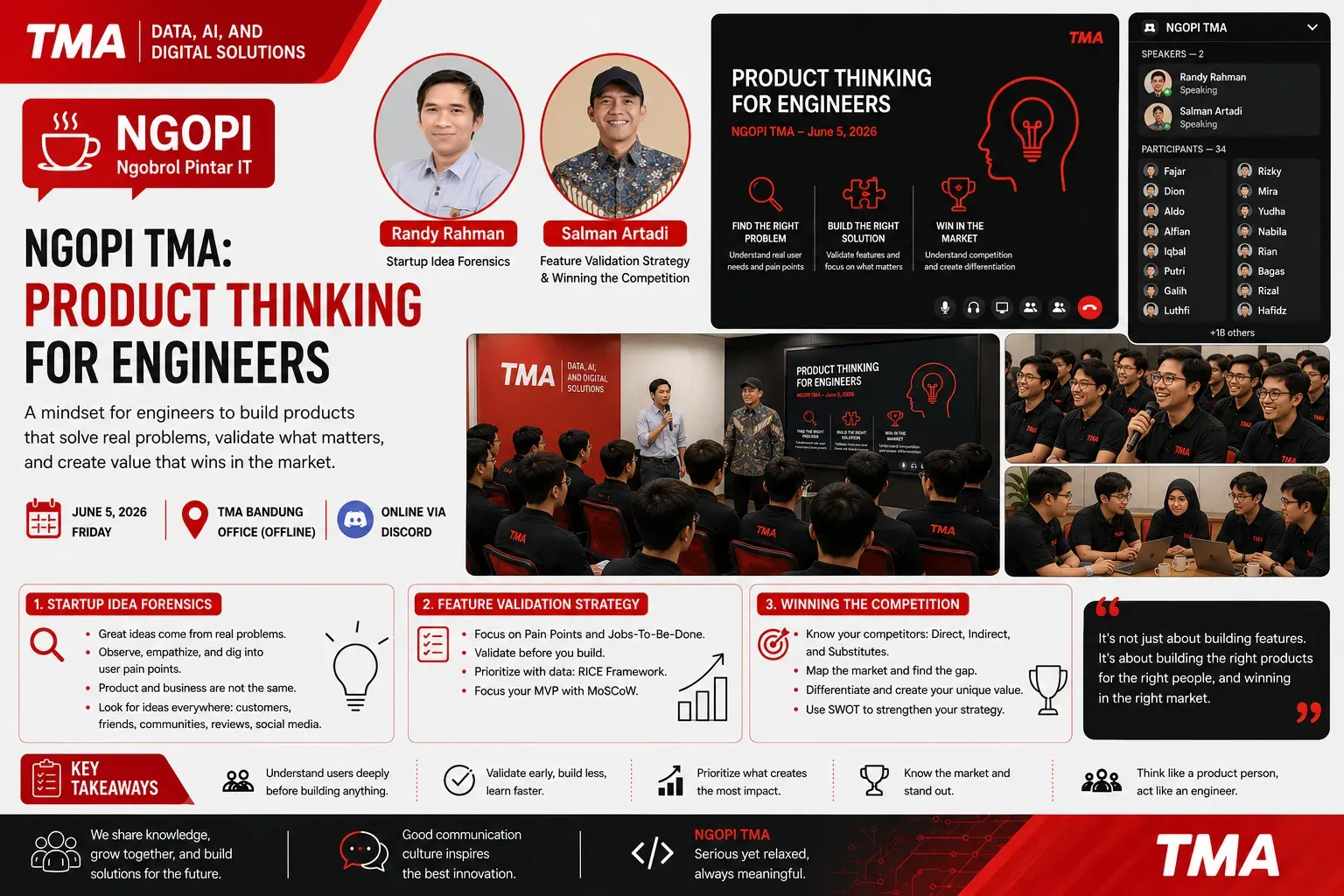
On 5 June 2026, TMA again held its regular internal event called NGOPI (Ngobrol Pintar IT), a knowledge-sharing forum that has become part of the company's learning and collaboration culture. This time the event ran in a hybrid format: online through Discord and offline at the TMA Bandung office. With this format, every team member could take an active part, whether working remotely or present in the office.
Unlike earlier themes that focused mostly on technology and technical implementation, this NGOPI raised a topic highly relevant to product and business growth: “Product Thinking for Engineers.” Two internal TMA speakers, Randy Rahman and Salman Artadi, presented the material. They invited participants to see product development from a wider perspective than just writing code or building features.
The first session was presented by Randy Rahman with the topic Startup Idea Forensics, a discussion that invited participants to understand how a good product idea is actually born. From the start, Randy stressed that great ideas do not always come from revolutionary technology, but from the ability to understand the real problems users face. He reminded the audience that many successful startups did not start with technology, but with observation of the everyday difficulties people face.
In his presentation, Randy explained examples of how large companies succeeded because they solved real problems. Tokopedia helped people find trusted sellers, Traveloka made it easier to search for and book travel, and Halodoc simplified the health consultation process. The same pattern appears in many other successful startups: they did not start with technology, but with a problem that needed solving.
The discussion then moved to an important concept: product and business are not the same thing. A product can solve a problem, but a successful business is one that solves a problem for many people who are willing to pay for the solution. Randy invited participants to look at product ideas from the view of market need, not just the technical ability the team has.
Interestingly, Randy also discussed that the best sources of ideas often do not come from the meeting room. Valuable product ideas usually come from customer complaints, coworkers, family, communities, and digital traces such as marketplace reviews, social media comments, and discussion groups. This message sparked a lot of discussion among participants about how engineering teams can get closer to user needs.
Moving to the second session, Salman Artadi continued with the topic Feature Validation Strategy. If Randy's session focused on finding a problem worth solving, Salman invited participants to understand how to decide which features are truly important to build. According to him, a common mistake in product development is focusing too much on a feature idea without first validating whether users really need that feature.
Salman explained the importance of starting from pain points and understanding Jobs-To-Be-Done (JTBD). Users do not actually buy features or products. They “hire” a solution to finish a job or solve a problem they face. By understanding basic user needs, product teams can build more relevant and valuable solutions.
One of the most interesting parts was the discussion of frameworks for prioritizing features. Salman introduced the RICE (Reach, Impact, Confidence, Effort) method as a data-based approach to set development priorities. This framework helps teams reduce subjective debate and focus on real business impact.
Participants were also introduced to the MoSCoW (Must-have, Should-have, Could-have, Won’t-have) method, which helps teams separate features that must exist in an MVP from features that can wait for the next iteration. This part led to a long discussion, because many participants linked it to projects they had worked on.
The last session was again presented by Salman, with the topic Winning the Competition. It covered how a product must understand its position in a competitive market. Salman explained that understanding competitors does not mean copying them. It means understanding the market landscape so the product can find strong differentiation.
Participants were invited to recognize different types of competitors, from direct competitors and indirect competitors to substitute solutions, which often pose the biggest threat. One interesting example was how a solution from a different industry can become a competitor because it solves the same problem.
The discussion then moved to the use of Competitive Landscape Analysis, Market Mapping, and Perceptual Mapping to identify market gaps that are not yet filled. Salman stressed that many business opportunities are born not from creating a new category, but from finding empty space that existing competitors do not serve well.
To close, participants were invited to use SWOT (Strengths, Weaknesses, Opportunities, Threats) analysis to understand the product's position more objectively. The discussion became livelier because many participants began connecting these concepts to the products TMA is currently developing.
As usual, NGOPI was very interactive. Sharp remarks came up during the discussion, from experiences building features that users never used to stories about engineers falling in love with a solution before really understanding the problem. Those jokes made a fairly strategic topic easier to digest and more enjoyable to follow.
Discord as the main platform again proved effective in supporting communication and collaboration. Online participants could interact directly with offline participants, share experiences, and ask questions in real time. There was no barrier between senior and junior engineers. Every participant had the same chance to share a perspective.
Through this NGOPI, TMA again showed that a modern engineer cannot rely on technology knowledge alone. Engineers also need to understand users, business, the market, and product strategy. By combining technical skill and product thinking, engineers can contribute more to solutions that work well and also give real value to users and the business.
NGOPI is more than a forum for sharing technology. It has grown into a shared learning space that brings engineering, product, and business thinking into one open, relaxed, and meaningful conversation. In an increasingly competitive industry, this kind of mindset will be one of the keys to TMA's success in building products that are relevant, innovative, and sustainable.