
Data & AI
NGOPI TMA: Exploring the Agentic AI era with n8n, from chatbot to self-directed intelligent agent
The journey then continued into the era of Large Language Models (LLM), where AI began to understand the context of human language more fully thanks to the rise of the Transformer architecture. At this stage, AI no longer only searched for information. It could summarize, understand, and produce responses based on the context it was given.
14 June 2026
Notes from the work
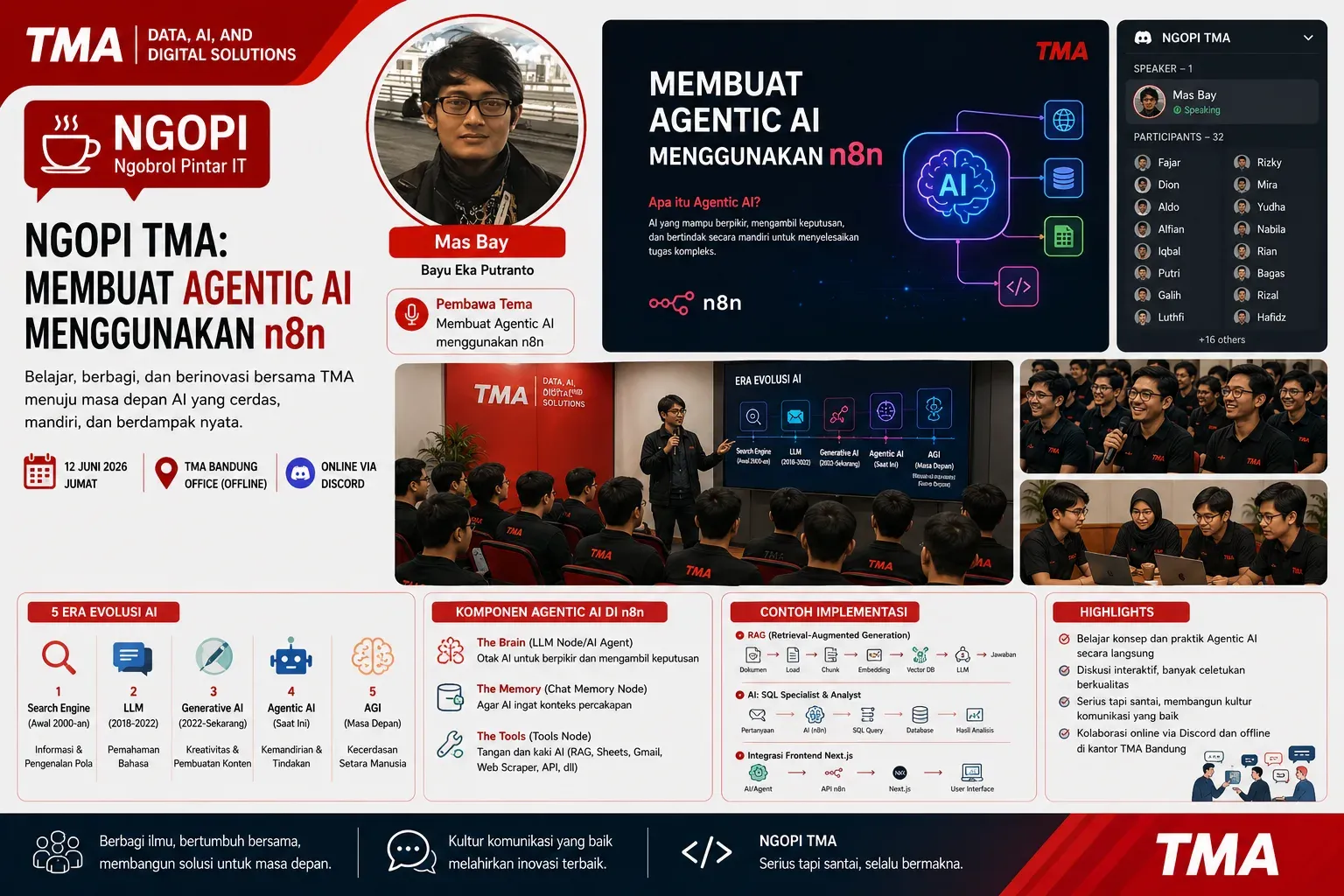
On 12 June 2026, TMA again held its regular internal event called NGOPI (Ngobrol Pintar IT), a knowledge-sharing forum that has become an important part of the company's learning and collaboration culture. This time the event ran in a hybrid format: online through Discord and offline at the TMA Bandung office. As usual, the mix of both formats let every team member take an active part without being limited by work location. It also strengthened the flexible working culture TMA keeps developing.
In this session, Bayu Eka Putranto, better known as Mas Bay, presented a theme that is very relevant to today's technology: “Making Agentic AI with n8n.” The material invited participants to understand how AI has evolved from a simple information search engine into an intelligent agent that can make decisions and carry out tasks on its own.
The room felt lively from the start. Mas Bay presented the material in a relaxed, communicative style, full of practical examples. Between technical discussions, the typical jokes of engineers and IT practitioners kept the mood light. Yet behind that relaxed atmosphere, the discussion stayed deep and full of insight. This is what makes NGOPI a forum the TMA team always looks forward to: serious in substance, relaxed in delivery.
Mas Bay opened the session by explaining the basic concept of artificial intelligence. He explained that AI is essentially an effort to train machines to imitate human thinking, from understanding language to solving problems. If AI once only carried out instructions written explicitly in program code, today AI can understand context and even predict what users need before they explain it in detail.
One of the most interesting parts came when Mas Bay took participants through the evolution of AI over time. He explained how the first era of modern AI was marked by the rise of the search engine, which focused on indexing information and matching keywords. At this stage, the system was still reactive and did not really understand the meaning of the information users were looking for.
The journey then continued into the Large Language Models (LLM) era, where AI began to understand the context of human language more fully thanks to the Transformer architecture. At this stage, AI no longer only searched for information. It could summarize, understand, and produce responses based on the context it was given.
Mas Bay then explained the explosion of Generative AI, which is now an important part of modern digital life. With platforms such as ChatGPT, Midjourney, and DALL-E, AI does not only understand information. It can also create new content, from text, images, and program code to video, based on a simple instruction from the user.
But the heart of this session was Agentic AI, described as the newest era in artificial intelligence. Unlike a conventional chatbot that only answers questions, Agentic AI can carry out more complex tasks on its own. If a user asks AI to do market research or write a report, Agentic AI can break the work into small steps, find the information it needs, use various tools, and finish the task without being directed step by step.
According to Mas Bay, this is the big change now taking place in the AI industry. The focus is no longer just on building a model that answers questions well, but on building an agent that can think, make decisions, and act to reach a certain goal.
On implementation, Mas Bay introduced n8n as a powerful workflow automation platform for building Agentic AI. He explained that n8n lets various services, AI models, databases, and business applications connect into one intelligent workflow that runs automatically.
Participants were then invited to understand the three main components of n8n-based Agentic AI. The first component is The Brain, the AI model or LLM that acts as the system's brain. In real implementations, users can choose from models such as OpenAI, Anthropic, Ollama, or AiTMA as the decision center. The second component is The Memory, which lets the AI agent remember context and earlier conversations so interactions feel more natural. The third component is The Tools, the various tools AI can use to finish tasks, such as RAG, Google Sheets, Gmail, Web Scraper, or a custom API.
The session became more interesting when Mas Bay showed a real implementation example through a Retrieval-Augmented Generation (RAG) workflow built with n8n. In the demo, participants saw how a document is processed, turned into an embedding, stored in a vector database, and then used as a knowledge source so AI can answer questions more accurately. The workflow diagram showed how each n8n node connects to build an integrated AI system.
Mas Bay also showed the AI SQL Specialist & Analyst implementation, an AI agent that translates a user question into a SQL query, runs the query against a database, and presents the analysis automatically. This demo drew the most attention because it showed how AI can help with data analysis without deep SQL skills.
To close, participants saw how the Agentic AI solution can be integrated with a Next.js frontend. The result is an application that is smart on the backend and easy for end users to use through a modern web interface.
As in earlier NGOPI sessions, the discussion was very interactive. Many questions came up about vector database use, the cost of LLM implementation, data security, and chances to apply Agentic AI in TMA products such as AiTMA, TeMA Data Platform, and TeMA News Analytics. Some participants even began to imagine how AI agents could automate internal work that is still done manually.
Discord as the main discussion channel again proved effective. Online and offline participants could interact in real time, share screens, discuss technical details, and brainstorm together without real obstacles. The open communication culture TMA has built looks more mature through forums like NGOPI.
Through this session, TMA again showed its commitment to keep up with the latest technology and to build internal capability relevant to future needs. Agentic AI is no longer just a futuristic concept. It is technology that organizations can start implementing today to work smarter, faster, and more efficiently.
This NGOPI gave participants more than a technical understanding of Agentic AI and n8n. It also opened new insight into where AI is heading. A future where AI is not only a helper, but also a digital work partner that can think, act, and work with people to solve business and technology challenges.