Enterprise Platform
NGOPI TMA discusses the Frappe Framework: the secret weapon behind ERPNext
From the start of the session, the room felt alive. Bambang opened the discussion with a relaxed but still technical approach, making fairly complex material easier to follow. Light jokes from participants and the speaker kept the forum flowing, while it stayed full of insight. The “serious but relaxed” culture that has long been NGOPI's signature felt strong again this time.
26 May 2026
Notes from the work
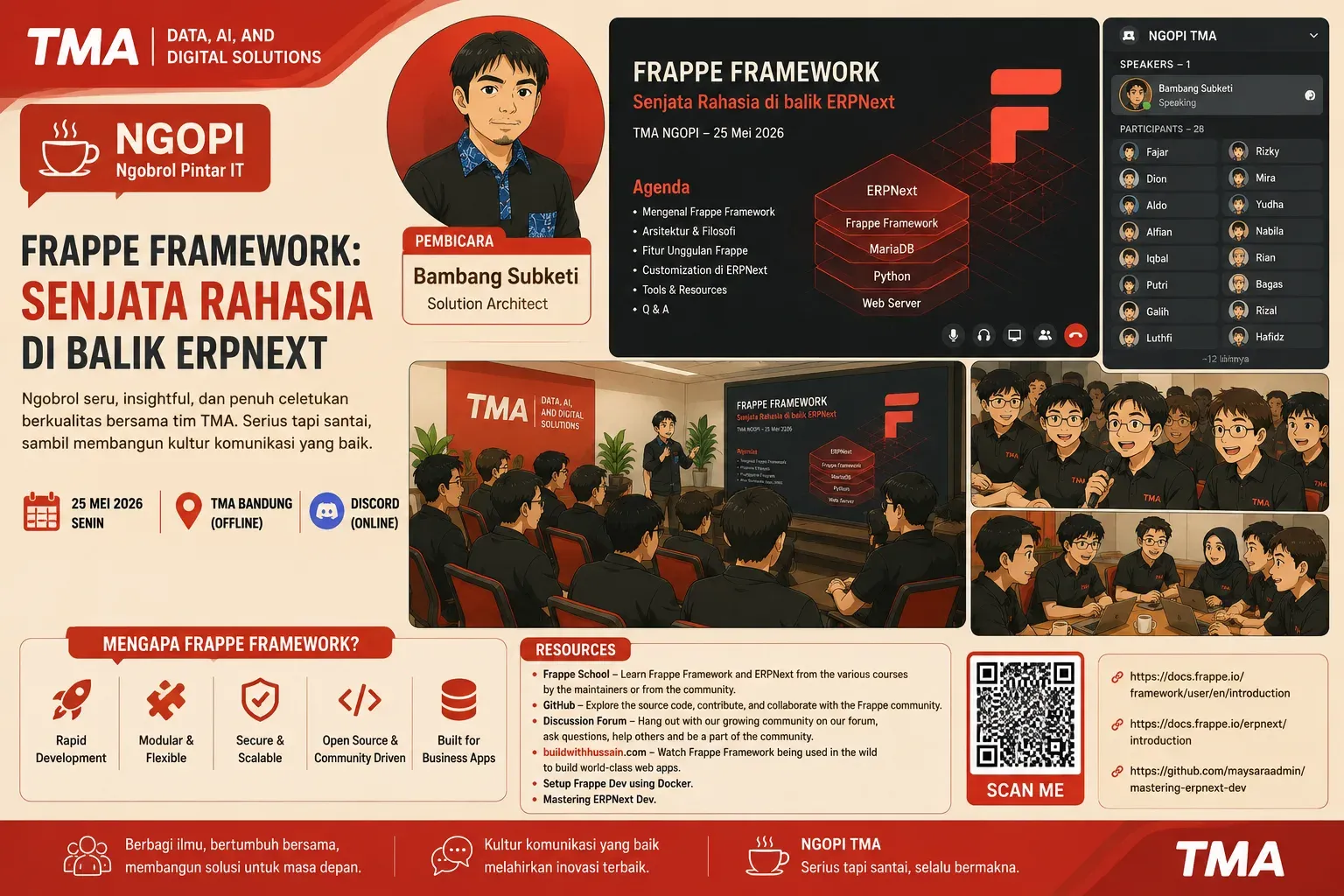
On 25 May 2026, TMA again held its regular internal event, NGOPI (Ngobrol Pintar IT), a technology discussion forum that has become an important part of the company's learning and collaboration culture. This session ran in a hybrid format: online on Discord and offline at the TMA Bandung office. With that format, every team member could take part without being limited by work location, reflecting the flexible work culture TMA keeps building.
The main theme this time was presented by Bambang Subekti, who raised an engaging topic: “Frappe Framework: the secret weapon behind ERPNext.” The material drew strong interest because ERPNext itself is one of the widely used open-source ERP platforms in many industries, while the Frappe Framework often stays the lesser-known part, even though it is the main foundation behind ERPNext's flexibility and strength.
From the start of the session, the room felt alive. Bambang opened the discussion with a relaxed but still technical approach, making fairly complex material easier to follow. Light jokes from participants and the speaker kept the forum flowing, while it stayed full of insight. The “serious but relaxed” culture that has long been NGOPI's signature felt strong again this time.
In his presentation, Bambang explained that many developers know ERPNext as a ready-to-use ERP application, but not all of them realize that behind ERPNext sits a very powerful framework, the Frappe Framework. This framework is not just an ordinary backend. It is a full-stack web framework that lets teams build business applications quickly, in a modular way, and at scale.
The discussion then moved to the basic philosophy of the Frappe Framework, which focuses on making enterprise application development easier through a metadata-driven architecture. With that approach, many development processes run faster than on conventional frameworks because developers do not have to build everything from scratch.
Bambang also explained how Frappe lets developers build systems on a flexible document-oriented model for many business needs. That is why ERPNext could grow into an ERP platform that adapts well to many industries and business processes.
The material drew on several official Frappe learning sources, including the framework and ERPNext documentation on the official Frappe site. Participants were also introduced to several key resources such as:
- Frappe School as the official learning channel
- The Frappe GitHub repository for exploring source code
- The Frappe community forum for technical discussion
- Various references for modern ERPNext development
One topic that caught participants' attention was how developers can build a custom application on top of ERPNext with the Frappe Framework without changing the core system directly. This approach makes system maintenance and upgrades much safer and more sustainable.
Bambang also covered how modern development on Frappe is now easier with Docker for environment setup. One resource discussed was the process of setting up Frappe Development with Docker, which helps developers build a consistent and faster environment.
The discussion grew more interesting when participants started talking about their ERP implementation experience and the challenges of customization in the real world. Many shared how traditional frameworks often make enterprise application development harder because they are too rigid or need a lot of effort for customization.
In that context, Frappe was seen as fairly unique because it bridges the needs of low-code and full-code development at once. Developers can use the built-in features of the framework to speed up development while still having high flexibility to build custom logic when needed.
This NGOPI session did not stop at technical matters. It also touched on the importance of open-source culture in modern technology development. Bambang stressed that the strength of Frappe and ERPNext comes not only from the technology itself but also from an active global community that shares knowledge, source code, and implementation solutions.
The discussion about the community became one of the liveliest parts of the event. Many participants talked about how open-source culture is actually similar to TMA's internal culture, which encourages knowledge sharing, open collaboration, and continuous learning.
Discord as the online medium again showed its effectiveness in supporting flexible technical communication. Online participants could ask questions right away through the voice channel or chat, with no formality barrier. Some offline and online participants even did live troubleshooting and shared development experience during the session.
The event got livelier when light jokes appeared about ERP debugging experience, dependency conflicts, and the “migration drama” developers often face. Though told with humor, these exchanges actually enriched the discussion because they carried real experience that other participants could relate to.
Behind the relaxed mood, NGOPI again proved its role as a healthy communication space at TMA. There is no wall between senior and junior engineers, no hesitation to ask, and every participant has room to share a perspective. This is an important foundation for building an engineering culture that is strong and adapts to technology change.
Beyond adding technical knowledge, the event also showed TMA's growing focus on building enterprise platform capability based on open source. With a deeper understanding of the Frappe Framework, the internal team is expected to build ERP and business application solutions that are more flexible, scalable, and suited to market needs.
Near the end of the session, many participants said they wanted to explore the Frappe Framework further, including the chance to use it in future TMA internal product development. The discussion continued casually even after the main session ended, showing high enthusiasm from everyone.
Through NGOPI, TMA again showed that learning technology does not have to be formal and stiff. With an open, relaxed, and collaborative approach, knowledge sharing becomes more alive and effective.
NGOPI is not just a forum for talking about technology. It has grown into a symbol of TMA's culture, a culture that believes innovation comes from healthy communication, high curiosity, and a spirit of learning together without limits.