
Digital Engineering
NGOPI IT at TMA covers FastAPI fundamentals: building modern APIs that are fast, safe, and ready for the AI era
The spirit of learning and sharing knowledge felt warm again at PT Tech Mayantara Asia (TMA) through the regular NGOPI IT (Ngobrol Pintar IT). On Friday, 6 June 2026, the whole TMA crew gathered again in a technology discussion forum held in hybrid format, offline at Kantor Magna and online through the Discord platform. This let all team members, whether working from the office or Work From Anywhere (WFA), join the session without trouble.
21 July 2026
Notes from the work
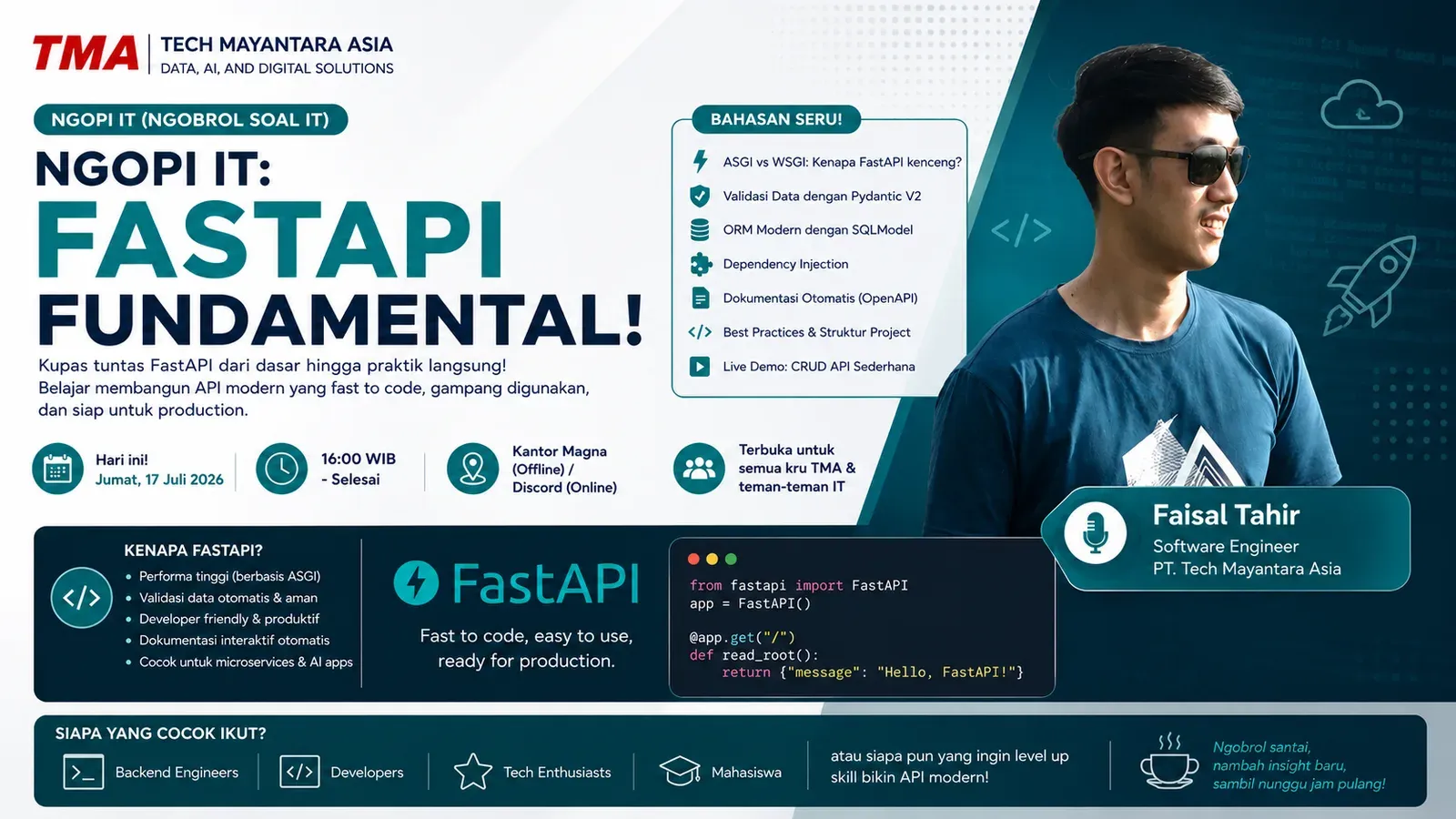
The spirit of learning and sharing knowledge felt warm again at PT Tech Mayantara Asia (TMA) through the regular NGOPI IT (Ngobrol Pintar IT). On Friday, 17 July 2026, the whole TMA crew gathered again in a technology discussion forum held in hybrid format: offline at Kantor Magna and online through the Discord platform. This let all team members, whether working from the office or Work From Anywhere (WFA), join the session without trouble.
Taking the theme "FastAPI Fundamental", this session was led by Faisal Tahir, who invited participants to understand the foundations of a modern Python backend framework that is now a main choice for REST API development, microservices, and backends for Artificial Intelligence applications. The material started from the most basic concepts to real implementation practice, so beginner developers and experienced engineers could both follow it.
From the start, the room felt lively. As usual, the forum ran relaxed without losing technical depth. Light jokes, real field experience, and stories about the challenge of building production backends made the discussion friendly and interactive. The "serious but relaxed" culture that marks NGOPI was there again, showing that learning works much better in an open and enjoyable setting.
Faisal opened the session by introducing what FastAPI actually is. He explained that FastAPI is a modern Python-based web framework designed to produce high-performance APIs without sacrificing developer productivity. The framework stands on two main foundations: Starlette as a modern web toolkit and Pydantic as a data validation engine that uses Python Type Hints. Together they let FastAPI produce backend applications that are fast, safe, and easy to maintain.
One topic that drew the most attention was why FastAPI has become so popular in recent years, especially for AI systems and microservices. Faisal explained that besides very high performance, FastAPI supports asynchronous programming natively with async/await, so a server can handle many requests at once using far fewer resources.
The topic of ASGI versus WSGI then became one of the parts that sparked the most discussion. With a simple restaurant waiter analogy, Faisal showed how the asynchronous approach lets a server keep serving other requests while waiting on an external process such as a database query, a third-party API call, or communication with a Large Language Model (LLM). This concept matters a lot in modern applications that depend on many external services.
Participants then learned why FastAPI can deliver such high performance. Besides using the ASGI architecture, FastAPI has a Dependency Injection system, automatic documentation based on OpenAPI, and automatic data validation through Pydantic V2. This approach speeds up development and also cuts the chance of bugs from data format errors that often appear in traditional backend applications.
The session then moved into practice. Faisal demonstrated how to build a simple FastAPI application with only a few lines of code. Participants saw the installation process with pip, creating the main.py file, running the server with Uvicorn, and opening the interactive Swagger UI documentation that the framework generates automatically, with no manual writing. For many participants this feature is one of FastAPI's biggest advantages because it speeds up development and makes communication between backend and frontend developers easier.
The material continued with Pydantic V2, the main data validation engine in FastAPI. Faisal explained how every incoming JSON request is checked automatically against the data types already defined. If there is a format error or a mismatched attribute, FastAPI returns an informative error response without manual validation logic. This makes API quality more consistent and safer.
The next topic, SQLModel, also drew strong interest. Faisal showed how SQLModel combines the power of SQLAlchemy and Pydantic, so developers no longer need separate models for database objects and API objects. This approach cuts code duplication, improves system consistency, and speeds up enterprise application development.
Because TMA now builds more and more Artificial Intelligence solutions, the session then turned to how FastAPI becomes the backend foundation for modern AI applications. Faisal explained the pattern for integrating FastAPI with AI Agents, Retrieval-Augmented Generation (RAG), Web Search services, and Large Language Models. With the asynchronous approach, FastAPI can handle communication with many AI services without making the server slow or unresponsive. This is the kind of architecture used in many modern generative AI products.
The session did not stop there. Participants also learned strategies for optimizing AI backends with techniques such as lifespan model caching, background task, and thread pool execution. This discussion is highly relevant to the direction of TMA internal products, including the AiTMA ecosystem, which relies more and more on integrating AI services and automated workflows.
One of the liveliest parts came when participants compared their experience with other frameworks such as Flask and Django. Faisal explained that FastAPI is not the answer for every kind of application, but it holds a strong position for modern REST API development, microservices, mobile app backends, and AI services. The comparison of performance, automatic documentation, data validation, and asynchronous support led to many interesting discussions about when a project should use FastAPI instead of other frameworks.
Between technical discussions, the room kept its typical NGOPI humor. Some participants told stories about learning async/await for the first time. Others shared debugging stories where an API failed because of a small mistake in a type declaration. Laughter came now and then, and it made everyone more active in asking questions.
The Discord platform again showed its role as the main collaboration medium at TMA. Participants joining online could ask questions through the voice channel or chat right away, while those at the office could still interact in real time. This hybrid model has become part of TMA's flexible work culture, which lets the whole crew keep learning together regardless of work location.
More than introducing a framework, the FastAPI Fundamental session showed how important it is to choose technology that fits future needs. As AI, cloud computing, and microservice architecture grow, the ability to build backends that are fast, safe, scalable, and easy to maintain becomes an important capability for every software engineer.
Near the end of the session, many participants said they were interested in adopting FastAPI on TMA internal projects, as a backend for web applications, mobile apps, enterprise integration, or AI platforms. The simple but thorough live demo gave a real picture that building a modern API is no longer as hard as it was a few years ago.
By running NGOPI IT consistently, TMA again shows its commitment to building a culture of continuous learning. The forum is a place to learn new technology and also a space for collaboration, sharing experience, and building a healthy engineering culture. With a spirit of learning together, open communication, and high curiosity, TMA believes innovation will keep coming from people who never stop growing.