
Enterprise Platform
NGOPI TMA discusses ERPNext/Frappe as a backend API: building fast, secure, and flexible application integration
The main speaker was Bambang Subekti, better known as Ibeng, long known as one of TMA's engineers with deep experience in developing solutions based on ERPNext and Frappe Framework. With a relaxed but still technical style, Ibeng turned a fairly complex topic into a discussion that participants from different backgrounds could follow easily.
22 June 2026
Notes from the work
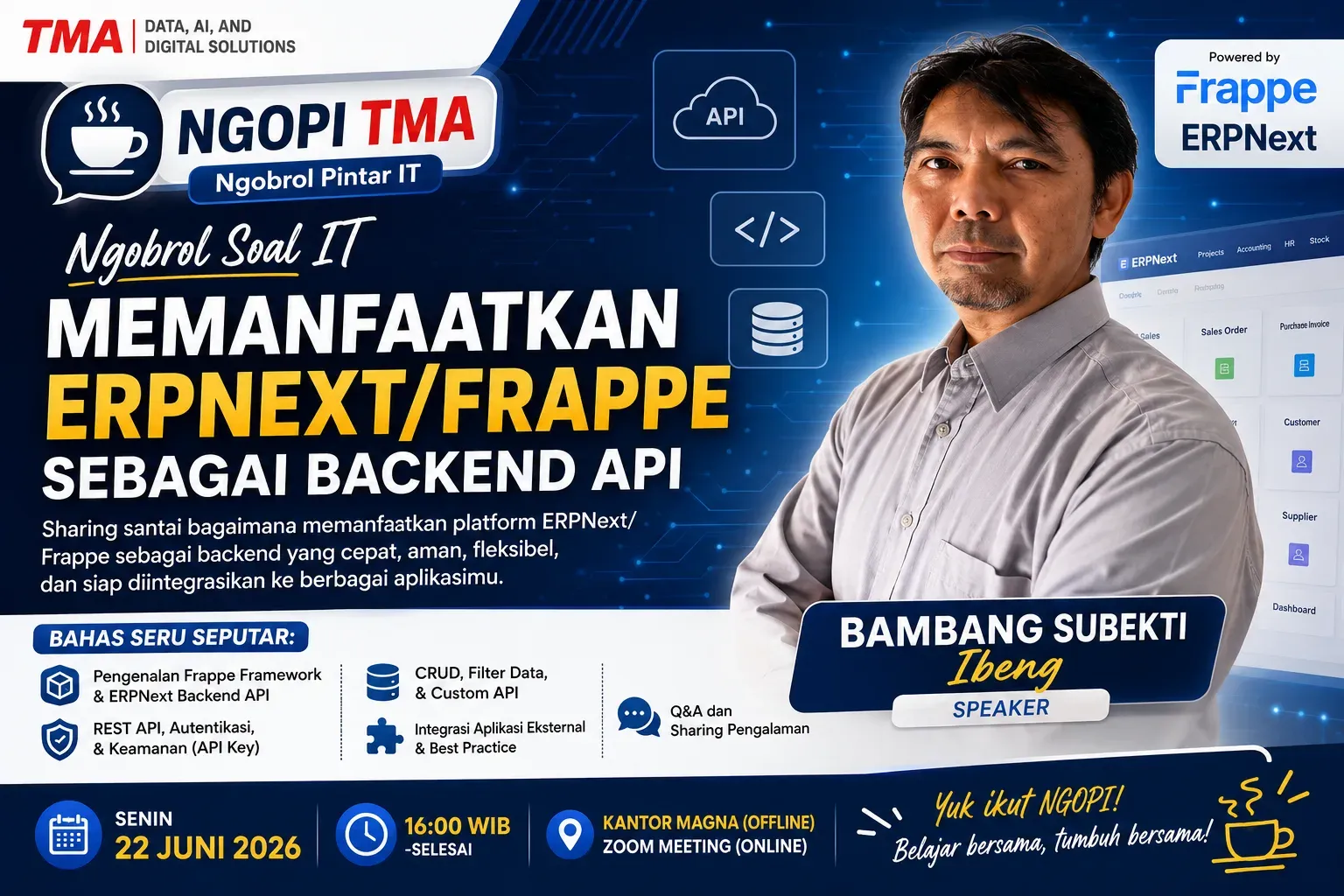
Bandung, 22 June 2026 — The spirit of sharing knowledge and building a strong engineering culture was alive again in the regular NGOPI (Ngobrol Pintar IT) event held by PT Tech Mayantara Asia (TMA). This time, the topic matched the needs of modern application development: "Using ERPNext/Frappe as a Backend API."
The event, held on Monday 22 June 2026 from 16:00 WIB until finished, ran in hybrid format. It combined an offline session at the Magna Bandung office and an online session through Zoom Meeting, so every team member could join without being limited by work location. This format has become part of the TMA work culture, which puts flexibility, collaboration, and equal access to knowledge sharing first.
The main speaker was Bambang Subekti, better known as Ibeng, long known as one of TMA's engineers with deep experience in developing solutions based on ERPNext and Frappe Framework. With a relaxed but still technical style, Ibeng turned a fairly complex topic into a discussion that participants from different backgrounds could follow easily.
From the start, the discussion was warm and interactive. Typical NGOPI jokes came up between slides. One person shared a failed API integration story caused by a wrong header configuration. Another joked about the "debugging ritual before deployment". Behind the relaxed mood, the discussion stayed serious and full of useful technical insight.
The material followed the Frappe REST API architecture blueprint, which explains how Frappe Framework already provides very strong API capabilities without complicated extra configuration. In his presentation, Ibeng explained that one of Frappe's biggest strengths is its ability to generate REST API endpoints automatically for every DocType in the system. With this approach, developers can build a backend service very fast without writing basic API code from scratch.
According to Ibeng, many developers know ERPNext only as a ready-to-use ERP application. Behind it, there is Frappe Framework, which can serve as an enterprise backend platform for many kinds of applications. By using standard endpoints such as /api/resource/<doctype>, developers can run CRUD operations on data right away without building an extra controller or service layer.
One topic that drew the most attention was the authentication mechanism. The session explained that Frappe provides several authentication methods, from session-based login and OAuth2 to the token-based authentication approach recommended for application integration. This token-based model uses a combination of API Key and API Secret sent through an Authorization Header, which allows secure and efficient server-to-server communication.
The discussion then moved to security. Ibeng stressed that API security is not only a technology question. It is also about governing user access. Every API call made with a token still follows the role and permission of the user tied to that token. So access control stays consistent without complicated extra security work.
In the next part, participants learned how to run basic data operations with the Frappe REST API. They covered fetching a data list, reading a specific document, updating, and deleting data through the standard endpoints that are already generated automatically. This explanation made many participants realize that modern application integration can move much faster than a conventional backend approach.
One of the most engaging sessions covered filtering and query parameters. In the demo, Ibeng showed how developers can pick the columns to return, apply complex filters, sort, and set pagination using only URL parameters. This approach lets a frontend application get data more efficiently and only what it needs, without processing extra data on the client side.
The material did not stop at standard CRUD. It moved to an advanced topic: Custom API and Remote Procedure Call (RPC). Here, participants were introduced to the /api/method/<dotted.path> endpoint, which lets developers run specific Python functions from outside the system. With this approach, complex business logic can be wrapped into a custom API that fits the application needs.
Ibeng explained that this feature is one reason Frappe is so interesting as a backend platform. Besides providing automatic APIs, the framework offers high flexibility for building custom services that standard CRUD endpoints cannot cover. Even so, every method that will be exposed needs a special decorator to stay secure and controlled.
The discussion became livelier when participants linked the material to projects they had worked on. Several shared experience integrating ERPNext with mobile applications, monitoring dashboards, approval systems, and analytics platforms. The discussion produced many new ideas on how Frappe can serve as the center of data integration between applications in an enterprise environment.
The session also covered techniques for handling file upload through the API. This feature matters because many modern applications need to upload documents, images, and other supporting files. With the available endpoints, file upload integration can be done from a backend or frontend application in a relatively simple way.
Interestingly, the discussion did not focus only on technical matters. Several participants also talked about architecture and implementation strategy. One topic that stood out was how Frappe can be an attractive alternative for organizations that want to build an integrated backend platform without developing every application layer from scratch.
In TMA's own context, this topic is very relevant to the direction of company products such as TeMA ERP, TeMA Platform, and other enterprise solutions that need strong integration with external systems.
As in earlier NGOPI sessions, the question and answer part was one of the liveliest. Questions ranged from best practice for using an API Key, permission management, and query optimization to stories of challenges when integrating with third-party applications. Each question led to further discussion that enriched everyone's understanding.
Near the end, Ibeng summed up the material in a "Frappe REST API Master Cheat Sheet". It contained a summary of key endpoints, commonly used query parameters, the authentication format, and basic rules for building a custom RPC service. Participants appreciated the summary as a practical reference they could use in daily work right away.
The event closed with a relaxed discussion that continued even after the official session ended. Some participants kept talking about application integration ideas, opportunities to develop internal products, and experience implementing ERPNext in different enterprise environments.
Through this NGOPI session, TMA showed again its commitment to building a learning culture that is open, collaborative, and relevant to today's technology needs. By understanding how to use ERPNext and Frappe as a backend API, the engineers gained not only new technical knowledge, but also a wider view of how to build systems that are fast, secure, flexible, and ready to integrate with modern business needs.
In the end, NGOPI is more than a technology discussion forum. It has become a shared space to grow, where ideas, experience, and inspiration are born and strengthen TMA's engineering culture over time. With a serious but relaxed mood, events like this keep proving that the best learning often comes from open conversation and a strong wish to share.