
Data & AI
Ngopi IT: building an AI foundation for the digital future
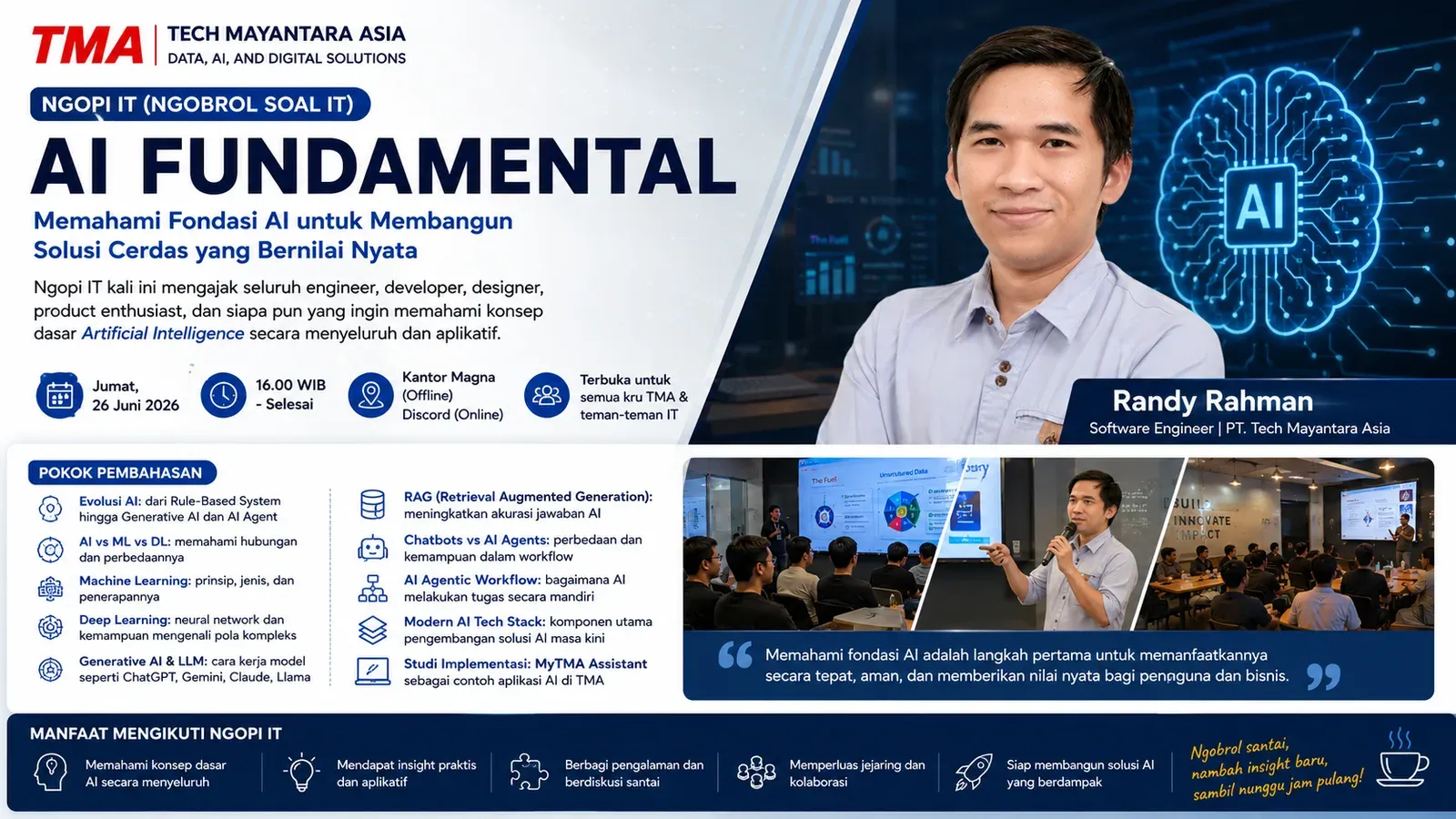
Bandung, 26 June 2026 – The growth of Artificial Intelligence (AI) has changed the way the world works, innovates, and makes decisions. Yet in the middle of that fast technology growth, many technology practitioners still ask, "What actually is AI?", "How does AI work?", and "Should I learn AI now?". To answer that need, PT Tech Mayantara Asia (TMA) held the regular program Ngopi IT (Ngobrol Soal IT) with the theme "AI Fundamental", a knowledge-sharing session on the basic concepts of Artificial Intelligence as a foundation before entering the more complex AI world. The material was delivered by Randy Rahman, Software Engineer at PT Tech Mayantara Asia.
27 June 2026
Notes from the work
Bandung, 26 June 2026 – The growth of Artificial Intelligence (AI) has changed the way the world works, innovates, and makes decisions. Yet in the middle of that fast technology growth, many technology practitioners still ask, "What actually is AI?", "How does AI work?", and "Should I learn AI now?". To answer that need, PT Tech Mayantara Asia (TMA) held the regular program Ngopi IT (Ngobrol Soal IT) with the theme "AI Fundamental", a knowledge-sharing session on the basic concepts of Artificial Intelligence as a foundation before entering the more complex AI world. The material was delivered by Randy Rahman, Software Engineer at PT Tech Mayantara Asia.
Held at Kantor Magna, Bandung, and joined online through Discord, the activity on Friday, 26 June 2026 at 16.00 WIB was attended by software engineers, developers, UI/UX designers, product enthusiasts, and students interested in Artificial Intelligence. In the spirit of Ngopi IT, the event was relaxed but still full of technical insight, so participants could discuss openly without formal barriers.
In the opening, Randy Rahman said AI is no longer just a technology trend. It has become a basic skill (fundamental skill) that every digital person needs to understand. In his view, many people jump straight into generative AI services such as ChatGPT or Gemini without understanding the basic concepts behind the technology. Understanding the foundations of AI helps someone use the technology more effectively, safely, and responsibly. That is also the main goal of the AI Fundamentals material: to build the right way of thinking about Artificial Intelligence before discussing more complex implementation.
The material started with the definition of Artificial Intelligence and why AI is one of the most influential technologies in the history of computing. Randy explained that AI is a branch of computer science that tries to make machines able to do tasks that used to need human intelligence, such as recognizing patterns, understanding language, making decisions, and solving problems. Unlike the common idea that AI means humanoid robots, most AI used today is software working behind the digital applications we use every day.
Participants then looked at the evolution of AI over more than seven decades. It started with the Rule-Based System era in the 1950s, which relied on rules written by hand. It continued to the Machine Learning era in the 1990s, when computers began to learn from data. Then came the Deep Learning era around 2012, which let AI recognize far more complex patterns through artificial neural networks (neural network). That evolution continued to the Generative AI era, which became popular with the arrival of the transformer model and Large Language Models (LLM), and to the newest development, the AI Agent, which can carry out a series of tasks on its own. This timeline shows that AI is the result of a long evolution, not technology that appeared overnight in the last few years.
One part that drew the most attention was the explanation of the relationship between Artificial Intelligence, Machine Learning, and Deep Learning. Randy used a simple illustration: AI is the big umbrella, Machine Learning is part of AI, and Deep Learning is part of Machine Learning. This helped participants understand why not all AI uses Machine Learning, and not all Machine Learning uses Deep Learning. With a simple visual approach, a concept that often seems complicated became much easier to understand.
Next, Randy discussed Machine Learning in more depth: the ability of a computer to learn from data without being programmed explicitly for every condition. Through an illustration of the training data and testing data process, participants saw how a model learns to recognize patterns in historical data before it can predict new data. He also explained the three main approaches in Machine Learning: Supervised Learning, Unsupervised Learning, and Reinforcement Learning, with examples of their use in industry such as sales prediction, customer segmentation, recommendation systems, and autonomous vehicles.
The discussion then turned to the importance of data as the "fuel" of AI. Randy stressed that the quality of an AI model depends heavily on the quality of the data used. He explained the difference between structured data, such as data in a relational database, and unstructured data, such as documents, images, video, email, and WhatsApp conversations. In his view, the rapid growth of generative AI in recent years happened because Deep Learning can understand unstructured data, which is far larger in volume than structured data. This opened participants' view that successful AI implementation depends not only on algorithms but also on good data management.
Moving into Deep Learning, Randy introduced the Neural Network, a computing model inspired by how the human brain works. By using many layers (hidden layer), Deep Learning can recognize patterns that were hard to learn with conventional Machine Learning methods. This technology is the foundation of modern AI abilities such as face recognition, natural language processing (Natural Language Processing), object recognition in images, and the recommendation systems used by many digital platforms.
The topic participants waited for most was Generative AI and Large Language Model (LLM). Randy explained how models such as ChatGPT, Gemini, Claude, and Llama work on the transformer architecture, which lets AI understand the context of a conversation and produce answers that resemble how people communicate. But he also reminded them that these models are not always right. So an approach such as Retrieval Augmented Generation (RAG) is needed to connect the AI model with organizational data sources, so the answers are more relevant, accurate, and fit business needs.
The session did not stop at generative AI. It also covered the newest development, the AI Agent. Randy explained the basic difference between a traditional chatbot and an AI Agent. A chatbot usually only answers user questions. An AI Agent can carry out a series of actions automatically: taking data from different systems, running analysis, executing a workflow, and producing a certain decision based on a set goal. This concept is expected to shape AI development in the coming years because it can significantly raise productivity and business process automation.
To close, Randy showed a picture of the Modern AI Tech Stack, from the application layer, Large Language Model, and Vector Database to the Embedding Model and other supporting components that make up a modern AI solution. He also introduced a real implementation example through MyTMA Assistant, an internal AI platform that shows how these components can be integrated into a solution that adds value for the organization. Through that example, participants got a real picture of how the AI concepts they had learned apply in a professional work setting.
Participants stayed enthusiastic throughout the session. The discussion covered technical concepts and also the challenges of implementing AI in a company, AI ethics, data security, and career opportunities in Artificial Intelligence. Questions about choosing an AI model, learning strategies, and the use of AI in software development showed how much interest participants have in a technology that is now one of the main drivers of digital transformation.
Through the Ngopi IT session on AI Fundamental, PT Tech Mayantara Asia again showed its commitment to building a culture of continuous learning in the company. In the middle of fast technology growth, the ability to keep learning is a main key for every technology person to adapt to change. By understanding the AI foundation correctly, engineers can use the newest technology and also design solutions that are more innovative, responsible, and bring real impact to business and society.
Ngopi IT is not just a forum for sharing material. It has become a collaborative space that brings different disciplines together to learn, discuss, and grow. Through initiatives like this, TMA hopes to keep creating a learning ecosystem that produces digital talent that is adaptive, innovative, and ready for the challenges of the Artificial Intelligence era.